Forget Music Fast
I've been writing repeatedly this month about "Kill Your Idol" themes. Here's one.
The funniest stand-up is probably a coworker who never tried it. The best musician is probably in a conservatory, having never set foot inside a studio.
Two years ago, I heard over and over about how Kendrick Lamar was “in the Library of Congress.” This sounded like quite a feat to people who think “Not Like Us” is a good song, which it’s not. Sorry, it was hype, not talent. The beat is garbage.
Only recently I realized just how nonsensical this viral claim was.
The Library of Congress has nearly four million sound recordings. There’s so much music in there that being “in the Library of Congress” isn’t an honor at all.
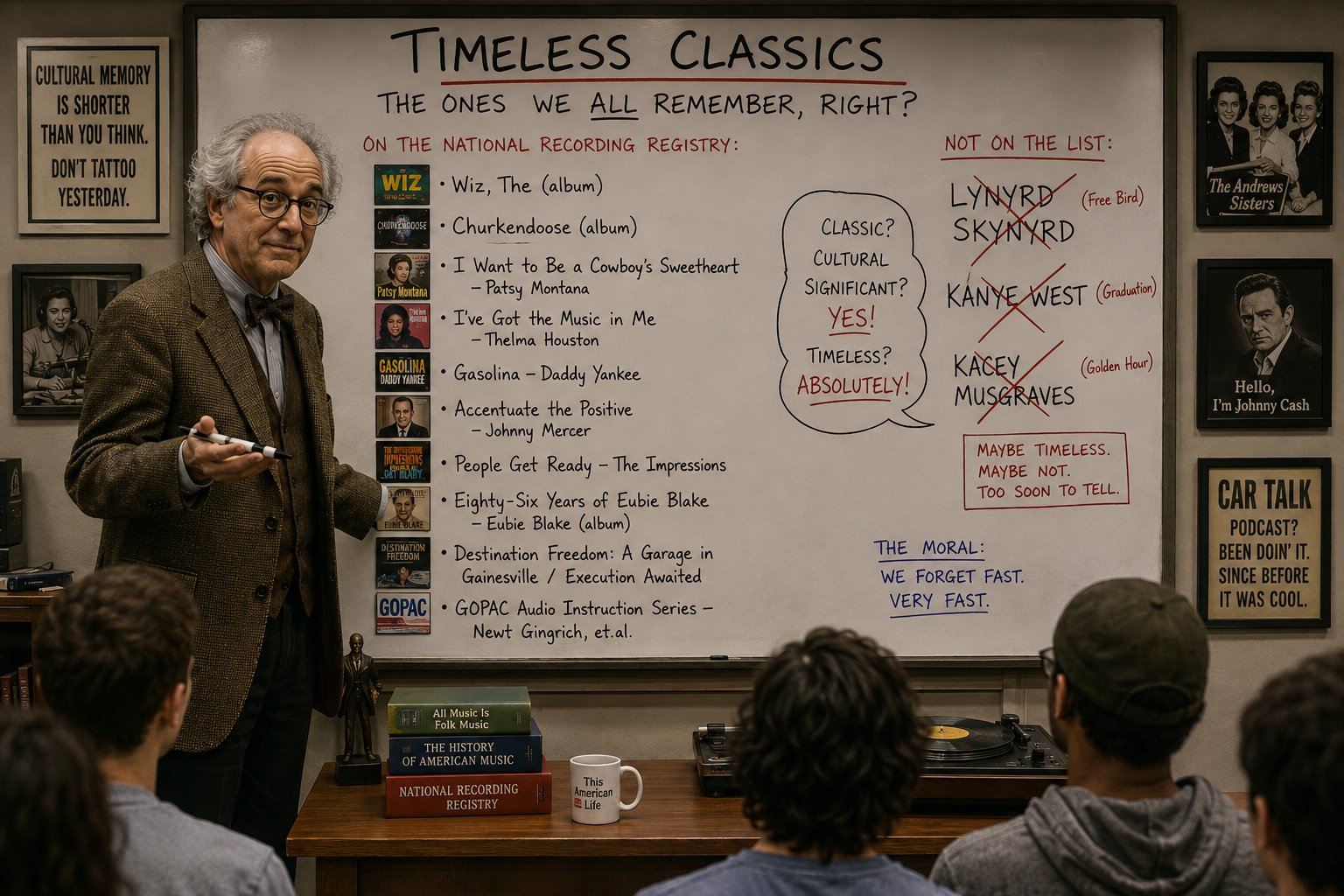
There IS a much more relevant and selective list: the National Recording Registry. It has 700 entries, selected because of their cultural, historical or aesthetic significance. Kendrick Lamar, as it turns out, is NOT on it. The list does have hits like the Andrews Sisters’ “Bei Mir Bist Du Schön” and the Ink Spots’ “If I Didn’t Care,” which might be one of the, idk, top five songs by the Ink Spots.
I wouldn't expect a prestigious recognition to go exclusively to songs I recognize, but I would expect to recognize most of them. But it’s strange to go through and it go “what’s that?" It’s a gov approved list, not Criterion Collection. I'd wager the average person would recognize less than ten percent, especially if you include the Pop (Pre-1955) section.
That isn’t to say the music is bad. These were the Kendrick Lamars of their time. It just means there is so much music. Songs can be absolutely massive, culturally important and inescapable, and then a single generation passes and almost nobody can name them.
And that's why I'm sorry to those still riding the high of a fake feud between the softest rappers to hit the Billboard charts, but I just cannot believe Kendrick Lamar’s last album will remain in people's memory. It's destined to be forgotten because it just isn’t as catchy as people let on. It feels more like, “Oh, yay, the legend behind good kid, m.A.A.d city did something with more political messaging and personal attacks. Those things are cool today.” I pray both politics and feuds are fads.
I don’t dislike Kendrick or Drake. Usually, I don't even think about them. If we're talking popular rap, I think about Tupac and Biggie more, despite both having been dead for decades. Gen Alpha knows their names. Whatever comes after Gen Alpha will discuss Tupac and Biggie too. That's what standing the test of time looks like. It’s not about albums sold, Grammys won or how many headlines a feud generated. It’s about longevity.
Rap aside, Americana, aka the epitome of the United States of America, is noticeably absent from this list, while all this cheese remains.
Take radio. For me, Car Talk was the absolute peak of American culture. Nothing is more “USA! USA! USA!” than two funny-talking radio hosts gabbing about open roads, weird car noises and people’s problems. You haven’t lived in America if you haven’t taken random advice from a humble giant.
Car Talk truly was the pinnacle of USAmerican culture. It just was. It’s like the pyramids were to Egypt.
And while I love A Prairie Home Companion and so many other NPR classics that were named, Car Talk was the most universally appreciated: cantankerous, highfalutin and lowbrow at the same time. It’s just something a cowboy and an Ivy League alum can both appreciate. I don’t think the named shows are nearly as universal.
Then there's rock and country. When I was in university, I found “Wagon Wheel” was a quintessential good-old-boy anthem. It didn’t matter I learned it late, it was clearly recognized. Or think how Skynyrd's “Sweet Home Alabama” and “Free Bird” are THE go-to songs for introducing a hot-blooded American, especially anyone from the South. None of the three makes the list. And these aren't cult classics that somebody dug up decades later. They were popular upon release and stayed popular.
Electronic music makes this even more obvious because it goes through a new “revolution” every couple of years. There were DJs and producers in 2005 who felt like the future of music, and another crop in 2010, 2012, 2014 who seemed destined to headline festivals forever. Entire genres went from underground, to everywhere, to sounding dated in a couple of years.
Daft Punk survived. The Prodigy survived. But for every one of them, there are twenty artists who were once on every festival poster and are now a “Right! I forgot about them!” moment on an old playlist. Electronic music just runs the experiment faster: being huge and feeling important right now are terrible predictors of what anyone will care about twenty years from now.
You could go through genre after genre and argue about what deserves to be there. But you will get angry, because what stands the test of time matters most. At one time, Van Gouh got snubbed, and now he’s immortal.
Cultural memory is way shorter than we think it is. If you think the latest meme is tattoo-worthy, wait a month and give it another thought.
Every generation produces music and media that feels permanent while you’re living through it. Most of it isn’t. So let's stop praising crap too early.
Thoughts?
Feel free to read a version of the list here: https://www.loc.gov/static/programs/national-recording-preservation-board/documents/registry-by-genre.pdf Then tell me if I under estimate the popularity of most of it or missed something.