Repost: Mitch’s Substack, ‘Israel’s At-Home PCR’
Why I’m Reposting
Remember Theranos and Liz Holmes? I’m sure a lot of investors do.
Blood-testing startups have earned themselves a permanent cultural stink. You can thank Theranos for that. TBF, you prob shouldn’t invest in a company that sounds like a villain the Avengers fight.
Well, this San Jose-based company isn’t hiding its tech like Theranos did. This is PCR, which is real. I know, I had to use it for a bio-lab in Uni 10+ years ago. The FDA granted Visby Medical marketing authorization for an at-home test for chlamydia, gonorrhea, and trichomoniasis that can be bought without a prescription, with results in about 30 minutes. It’s worth looking into, not just for STD-results, but for the other impact it will have on health.
By the way, yet again, this innovation comes from an Israeli. Adam de la Zerda, was born in Israel, studied at the Technion, and is now a professor at Stanford. As I’ve pointed out many times, the U.S. relies on Israel’s brain drain. Half the innovation and Fortune 500 companies are propped up by people hated for existing. This is another Israeli invention aimed at something people actually need. Please, go ahead and boycott it BDS, like you never did with Polio vaccines.
Visby Medical is still a private company, so there is no public ticker like Apple or Nvidia. It has raised hundreds of millions from institutional and venture investors, including a 2025 round led by Catalio Capital Management, with participation from investors such as Pitango Ventures, Cedars-Sinai Medical Center, and John Doerr. For normal retail investors, the practical options are limited: watch for a future IPO, see whether any publicly traded company partners with or acquires them, or, if you are an accredited investor, look into private-market platforms or funds that have exposure to late-stage medical-device companies. In other words: interesting company, not yet a “click buy on Robinhood” situation.
For clarity, I once had a rule against reposting the same person’s Substack twice, and I posted Mitch once before. So yes, I am breaking my own rule. But 1. I think this is a super important product to learn about, and 2. Mitch’s Substack remains weirdly under-read for how much good content he regularly puts out. So go read the full piece there and give him a follow, or whatever people do with Substack. I still don’t know.
Original link: https://sharingfromisrael.substack.com/p/visby-medical-israel-pcr-sti-test-home-fertility Copied below if you’re on the fence about giving Mitch a follow.
An Israeli Engineer Shrunk a Sofa-Sized Lab to the Palm of Your Hand. The FDA Called It a New Category.
Nearly 100,000 American women lose their fertility every year from infections they never felt. The pathogen was never the problem. The wait was.
Apr 23, 2026;
She felt fine.
No pain. No symptoms. No reason to suspect anything. She went to work, made plans for the weekend, thought about her future. Somewhere in her reproductive system, chlamydia was quietly ascending from her cervix into her fallopian tubes, leaving scar tissue where it traveled, closing off what it touched. She’d find out later, when the trying started and nothing happened and the doctor ran the tests and said the words. By then the damage was permanent. Not difficult. Not reversible with the right protocol. Permanent.

Is this an AI girl? I don’t know.
This isn’t the exception. It’s the overwhelming pattern. Chlamydia produces no symptoms in roughly 80% of the women who carry it. Gonorrhea is silent in about half. Trichomoniasis, the most common curable STI on earth, shows nothing in 70% of cases. Untreated, 10 to 15% of women with chlamydia or gonorrhea develop pelvic inflammatory disease. Of those women, 20% lose the ability to conceive. Almost 100,000 Americans cross that line every year.
The infections are treatable. The fallopian tubes they scar are not.
A Technion-trained engineer at Stanford decided that was an engineering failure. Then he fixed it.
The Testing System Was Designed for Sick People Who Showed Up
An appointment. A clinic. A queue. A sample collected in a setting that announces to anyone watching exactly what you’re being tested for. Then 24 to 48 hours if the lab is on-site, 6 to 13 days if the sample goes out, which is standard in most settings. During that window, the infection continues. The woman goes home without knowing. The doctor prescribes a treatment without a confirmed diagnosis, because waiting nearly two weeks for a result from a patient sitting in front of you isn’t medicine. Dr. Gary Schoolnik, Chief Medical Officer at Visby Medical and Professor of Medicine at Stanford, named this plainly: “We are fighting blind.”
Fighting blind means prescribing the wrong antibiotic for the wrong pathogen. It means building resistance into gonorrhea, which the CDC has already flagged as one of the most urgent antibiotic resistance threats in the country. And it means sending a woman home without a diagnosis when what she needed was direction toward the right care before the window closed.
That last point matters for gonorrhea specifically, because first-line treatment is injectable ceftriaxone, a clinic visit, not a pharmacy pickup. That’s precisely why early detection through a rapid test is clinically critical, not merely convenient. Without the test result, there’s no path to treatment at all.
Behind all of that is the woman who never went to the clinic in the first place. Because the system required too much of her and gave back too little. More than 9 million women are diagnosed with an STI in the United States each year. The CDC is explicit that this figure is a significant undercount. Asymptomatic infections go undiagnosed at scale because the testing system was built for people who already felt something.
This isn’t a public awareness failure. Women know STIs exist. It’s a design failure. And a Technion-trained engineer saw it that way.
He Lost a Friend to a Brain Tumor. Then He Decided Engineers Have a Role in Medicine.
Adam de la Zerda grew up in Israel, studied computer engineering and physics at the Technion summa cum laude, and was heading toward quantum computing when a close friend was diagnosed with a brain tumor and died. He pivoted completely. PhD in electrical engineering at Stanford in 2011. Postdoctoral work at UC Berkeley. Joined the Stanford Medical School faculty in 2012 as its youngest tenure-track professor. Forbes 30-under-30 in Science and Healthcare, twice. NIH DP5 Early Independence Award. Chan-Zuckerberg Investigator. TED Talk on cancer imaging with over a million views.
None of that is what matters here. What matters is the question he started asking in 2010, before any of the recognition arrived.
PCR, polymerase chain reaction, is the gold standard of infectious disease diagnosis. It doesn’t look for the body’s immune response to a pathogen. It finds the pathogen’s own DNA directly. PCR can’t be fooled by an infection that hasn’t yet triggered symptoms, because it doesn’t care about symptoms. It cares about whether the genetic sequence is present. When PCR says positive, the pathogen is there. That’s why no clinician second-guesses a PCR result.
The problem: PCR has always required a machine the size of a piece of furniture. To run the test, you heat a sample, cool it, heat it again, repeat that cycle 40 times with extraordinary precision, and measure what amplifies. The instruments that do this reliably weigh hundreds of pounds, require constant calibration, and live in certified laboratories. You can’t miniaturize them by simply making them smaller, because the chemistry and the thermocycling physics resist compression. For decades, nobody in diagnostics seriously asked whether the whole process could be redesigned from the ground up into something disposable.
De la Zerda asked it. His question: can every element of PCR, the sample preparation, the reagents, the heating and cooling, the 40 amplification cycles, the fluorescent detection, be integrated into a single-use device that fits in a palm and returns a result in 30 minutes? That’s not a modest engineering question. It’s the kind of question that sounds obvious after someone answers it and sounds impossible before they do.
He spent seven years finding out. First functional prototype in 2017. NIH-sponsored FDA clinical study in 2019. Results published in The Lancet Infectious Diseases in 2020. The Lancet called the device “potentially the new gold standard for point-of-care tests for infectious diseases.” In March 2025, the FDA authorized the at-home version under the De Novo pathway, meaning it created an entirely new regulatory category, because nothing like it had existed before.
He named the company Visby Medical.
What Thirty Minutes and a Swab Actually Means
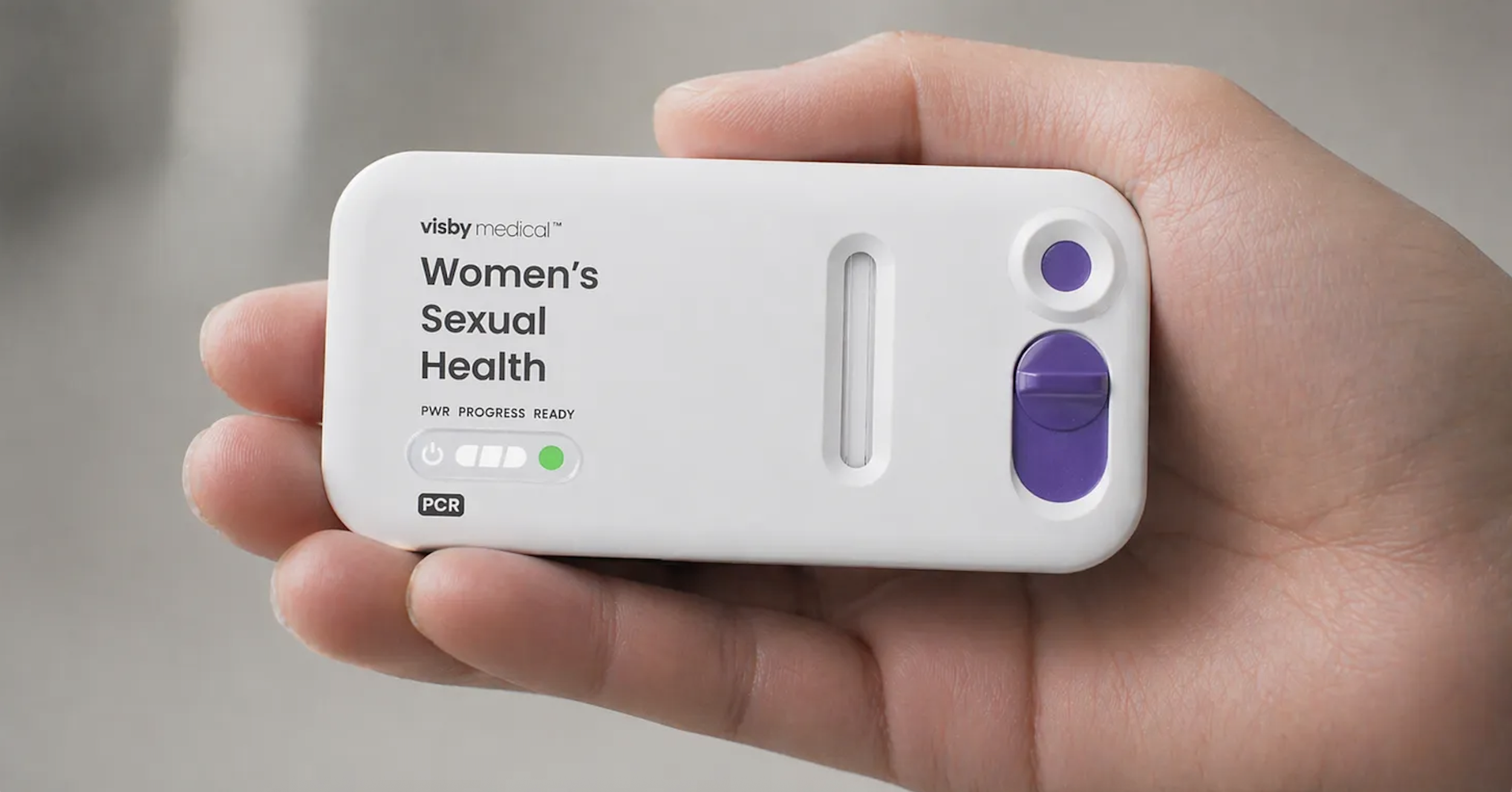
A woman orders the kit through Quest Diagnostics, Labcorp OnDemand, Everlywell, DoorDash for same-day delivery in 10 major cities, or Wisp, the largest women’s telehealth company in the United States, which announced its Visby partnership on April 16, 2026. She opens the app, collects a vaginal swab in under 15 seconds, inserts it into a device the size of a computer mouse, and waits. The device runs a full 40-cycle PCR analysis for chlamydia, gonorrhea, and trichomoniasis simultaneously. Thirty minutes later, the result appears on her phone. Privately. At home. Without a waiting room, a queue, or anyone else in the room.
The clinical performance, from a multi-site study across 13 geographically diverse U.S. locations from March 2023 to April 2024 with 2,293 women: for chlamydia, 97.2% sensitivity and 98.8% specificity; for gonorrhea, 100% sensitivity and 99.1% specificity; for trichomoniasis, 97.8% sensitivity and 98.5% specificity. These aren’t home-test numbers qualified by asterisks. They’re equivalent to what a high-complexity centralized laboratory produces with equipment that costs a million dollars and takes days to return a result.
Before Visby, the fastest common alternative at the point of care was an antigen test. An antigen test detects proteins on the surface of a pathogen; it works when the infection load is high enough to produce them. In asymptomatic women, where infection load is often still low, antigen tests produce false negatives at exactly the moment accuracy matters most. PCR detects the pathogen’s DNA directly, at concentrations antigen tests can’t reach. The woman who tests negative on an antigen test and goes home untreated is precisely the woman this piece is about.
For chlamydia and trichomoniasis, a positive result connects immediately to a telehealth provider through the app, a prescription is written, and oral antibiotics reach a pharmacy within hours. For gonorrhea, the positive result tells her she needs injectable treatment and directs her to the right clinical setting before the infection advances. In every case, knowledge arrives before the damage does.
The Receipts the Diagnostics Industry Took Seriously
The Lancet Infectious Diseases. Not a trade publication. When The Lancet calls a palm-sized device a potential new gold standard, the scientific community reads that differently than a press release.
When COVID hit in March 2020, John Doerr, one of Silicon Valley’s most consequential investors, called de la Zerda personally to ask what Visby was going to do about the pandemic. The answer: reprogram the same hardware for a different genetic sequence, get FDA emergency authorization in September 2020, and deploy at scale. That’s the detail that separates Visby from a single-disease diagnostic. The platform’s a miniaturized PCR engine. The pathogen it detects is a software decision, not a hardware one. STIs today. Flu and COVID. Antibiotic-resistant gonorrhea through a CARB-X-funded program awarded in February 2024. Whatever the next outbreak requires.
The NIH funded the original clinical trial. BARDA awarded $12.3 million for flu-COVID platform development. The NIH separately gave $19 million in the Antimicrobial Resistance Diagnostic Challenge, where Visby was the only winner in its category. Four U.S. government agencies have put serious money into an Israeli-founded company because the science is sound and the need is documented.
Visby has raised $487 million. Pitango Ventures, an Israeli VC, backed it from the start. TIME named de la Zerda to its 100 Most Influential People in Health for 2026. The test’s available today on Quest, Labcorp, Everlywell, DoorDash, and Wisp. Not coming soon. Today.
Israel Doesn’t Fix Broken Systems. It Removes the Constraints Everyone Else Accepted as Permanent.
The sofa-sized PCR machine wasn’t a broken system. It was state of the art. The diagnostics industry built an entire infrastructure around it and called the result the best medicine could do. What changed isn’t that the system failed. What changed is that a Technion-trained engineer looked at the constraint everyone else treated as a ceiling and asked whether it had to be one.
It didn’t.
That machine now fits in a palm. It ships to any address in the United States. It sits on a bathroom counter in any of the 10 cities where DoorDash delivers it the same day. No clinic. No queue. No one watching. Just a result, in private, in 30 minutes, before the damage has a chance to begin.
A device the size of a computer mouse. A swab. An app. Thirty minutes.
She picks it up. She knows.
Thoughts?
I think this is the future. Hopefully reusable down the line. Imagine not having to go to the doc to get tested. Just prove your competency, and when you really need an antibiotic get it easier than ever. We can dream.