Repost: ThinkChina on baizuo (aka the white left)
People who see the world primarily through their English-centric social media feed forget that the vast majority of the world is not USAmerican. I have had people insist I must be in the US simply because I was on Facebook, revealing a startling lack of understanding of how the world works, how the internet works, sometimes even how time zones work.
This is why I think the term baizuo needs to enter the broader lexicon. It serves as a reminder to the white left that they are not nearly as righteous as they are unapologetic and stubborn. I am not interested in flattening all Chinese people into one monolith, especially knowing that certain regions have relatively high LGBT+ acceptance for the East. That said, every dark-skinned (and blonde) friend I have who has visited East Asia, especially China, has commented on how visibly they were stared at, studied, or treated as an oddity by the local population.
Don’t be that guy who tells everyone that ‘MENA culture is misunderstood, but, also, leftist values are universal.’
Most of the world does not know that the famous “Tank Man” photo from Tiananmen Square emerged from a chain of protests, the first of which was explicitly racist in nature. “Hey China, Africans are not stealing your women!” Nor does the left understand what it feels like to sit in a Chinese movie theater where casual racism is normal. Sorry, Disney creatives.
Despite the regressive left’s insistence that only the whites are racist—casually insisting Jews get to be in this group—it is worth repeating anyone can be racist. Tom Segura jokes about Latin Americans being the most racists, while my friend Shing Shing (and many other Asian friends) insist the East has even Ari Shaffir’s The Amazing Racist beat.
Watching the self-hatred and scapegoating embraced by political extremes is what ultimately drove me away from identifying with either side. I consider myself left of center, but baizuo culture pushed me away from calling myself “left.” The baizuo will turn on anyone to avoid accountability.
Beware the baizuo. Beware.
I am not familiar with ThinkChina and cannot be bothered to investigate them deeply, but since I am reposting their work, I recommend you check them out. I was simply looking for a serious article on this term. This was the most comprehensive and authenti I found. Original link:
https://www.thinkchina.sg/society/why-first-gen-chinese-immigrants-us-detest-white-progressive-ideals
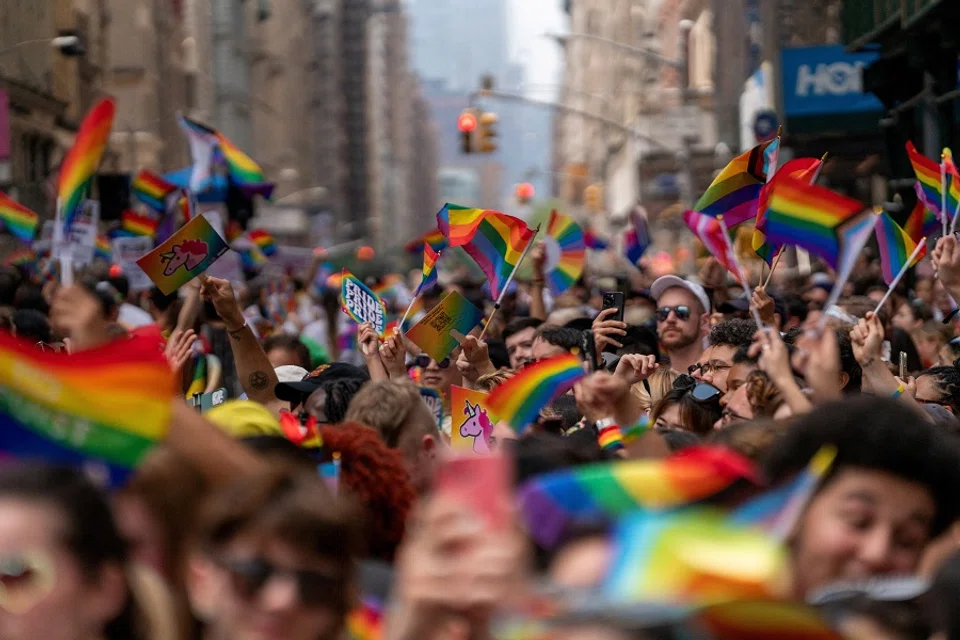
People participate in the 2023 NYC Pride March in Manhattan, New York, on 25 June 2023. (David Dee/Reuters)
Why first-gen Chinese immigrants in the US detest white progressive ideals
Issues such as gender diversity and environmental protection seem to be too abstract for first-generation Chinese immigrants in the US, who see these problems as having no impact on day-to-day life. US academic Wu Guo mulls over the reasons why this group of new immigrants, for all their desires to be part of the American education system, is a staunch detractor of progressive ideals that are part and parcel of the system itself.
Wu Guo; Sep 08, 2023
In February, a ThinkChina reader, who described herself as a white American female, sent me an email to ask about my view on first-generation Chinese immigrants.
She wrote that around half of her neighbours were well-educated first-generation Chinese immigrants who held tech-related degrees from American institutions and worked in the tech industry.
She had two main queries: firstly, why do highly educated Chinese immigrants have such strong feelings against illegal immigrants? Is it because of their own status as legal immigrants? Secondly, why do the Chinese immigrants use the term baizuo (白左, white left) as a pejorative slur to describe white progressives who care about social justice? And why do Chinese immigrants detest the baizuo?
Baizuo's overzealous concerns
My insights on baizuo had stemmed from my own family; in particular, my elder sister who has been residing in Melbourne for over a decade. Through her participation in global volunteer programmes for hospice care and Chinese orphans who were adopted by families in Western countries, my sister connected through WeChat with a few Chinese that had recently migrated to the US and was privy to their disdain for the baizuo. She wanted to know how I viewed them as someone living in the US for more than 20 years.

People watch street performers in Times Square, New York City, on 16 June 2023. (Leonardo Munoz/AFP)
While searching online for the definition of baizuo, I found that the term was first used in 2010. It is perhaps a prime example of a Chinese expression coined in the Internet era that gained traction internationally.
On the whole, it appears that the American reader had the right impression; the term baizuo used by the Chinese immigrants indeed had negative connotations. In her eyes, this particular group of white progressives (which perhaps included herself) merely consists of people who want to push for social justice and spur social progress. She was thus confused about the staunch anti-baizuo sentiment from the Chinese immigrants about a group of people who had an inherent moral legitimacy.
It appeared that my sister had also interacted with the same anti-baizuo group - those who studied in the US and worked in STEM fields, also known as the science and engineering students (理科生) in the mainland.
Another reason is the preferential policy for Black and Hispanic students entering high schools, which is seen as a threat to second-generation Chinese immigrants who consistently do well in their studies.
These Chinese science and engineering students living in the US mock the baizuo for a few key reasons. For one, the attitude towards illegal immigrants, which the American reader had pointed out. She mentioned that in the area where she lived, a Chinese professor openly called illegal immigrants "ghetto thugs", to which the other Chinese immigrants concurred.
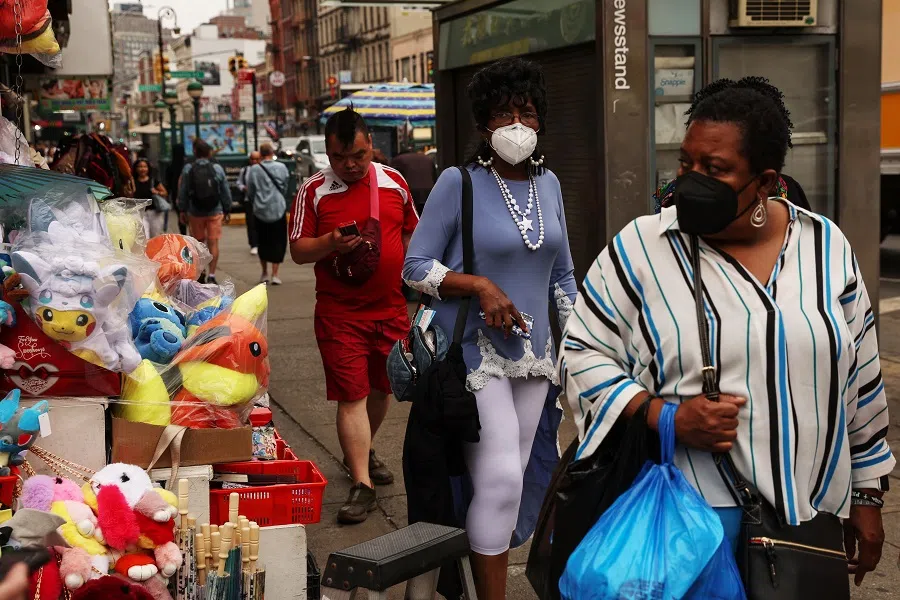
People walk down Canal Street in the Chinatown neighbourhood of New York City, 12 June 2023. (Shannon Stapleton/Reuters)
Another reason is the preferential policy for Black and Hispanic students entering high schools, which is seen as a threat to second-generation Chinese immigrants who consistently do well in their studies. A third reason would be the baizuo's inclusive attitude towards gender issues, and their acceptance (or indulgence) of transgenders and homosexuals, all of which rub the conservative minds of Chinese immigrant parents the wrong way.
Furthermore, the Chinese immigrants, who are very focused on getting real results, dismiss the baizuo as making a mountain out of a molehill and for getting on their high horses with overzealous concern about issues such as global warming and animal rights that have no apparent impact on day-to-day life.
Who are the baizuo and their detractors?
Before discussing these values, I would like to look into two crucial questions: who are the baizuo, and who are the anti-baizuo Chinese immigrants?
I am inclined to believe that, if we assume the baizuo are "white progressives who care about social justice", we can safely say that this group comprise of the middle and upper middle class in the US, who are more sympathetic and righteous.
They want, at least subjectively, to promote a society that is more inclusive of people of different sexual orientations, more compassionate for desperate illegal immigrants, and more attentive to the future of humanity and the ecological crisis. The latter includes global warming, which many believe to be exaggerated, and endangered creatures such as the skinny, bony polar bears in news pictures.
The baizuo also supports globalisation, more so than the average American, and is more accepting and appreciative of foreign culture. That is why many Hollywood stars and college professors fit the mould of the typical baizuo, as some would consider these groups of people as having the liberty to live off the fat of the land.
Many people think the baizuo is exaggerating trivial matters and showing excessive empathy, but they miss the truth that in American society - and in fact, in all societies - it is the powerful who oppress and marginalise the weak.

A polar bear looks for something to eat near Churchill, Manitoba, Canada, on 4 August 2022. (Olivier Morin/AFP)
I also believe that the white progressives in US society belong to the elitist camp; one could consider these elites as more "soft-hearted". But their presence acts as an important counterbalance to another part of US society - that of stark social Darwinism and racism. The baizuo are a relatively important symbol of moral significance, and they are a practical force pushing for fair and protective measures in the legal sphere. Indeed, it was the progressive left that spurred the protection of labour and the proliferation of welfare systems globally after the Second World War.
Many people think the baizuo is exaggerating trivial matters and showing excessive empathy, but they miss the truth that in American society - and in fact, in all societies - it is the powerful who oppress and marginalise the weak. On this note, I am a firm supporter of the protection of the rights of gender minorities.
Defending personal interest
Looking at the backgrounds of Chinese immigrants who are fiercely anti-baizuo, the bulk of the first-generation Chinese immigrants benefited from factors such as the immigration policy and the quality of higher education in the US. They were "academic superstars" who gained their master's degrees from American institutions and stayed on in the US to work in tech jobs.
This differs greatly from the Chinese in countries such as Canada and Australia, who typically immigrated as skilled professionals or immigrant investors, and most likely have more diverse life experiences. In terms of the educational field, most mid-to-old age Chinese immigrants in the US graduated from the top Chinese schools in science and engineering, and subsequently worked in the tech industry.
In the American workplace, Chinese immigrants with a science and engineering background working in tech, have a much easier time than those with a humanities background. This also meant that the former occupied a more dominant position than the latter among immigrants of the same age and experience, and thus the anti-baizuo sentiment rings louder. Chinese immigrants with a humanities background are more likely to accept the baizuo's values and ideas, including being more gender inclusive.
... they do not want their children to be "corrupted" by any non-mainstream gender pluralism; nor do they want their children to be concerned with abstract topics such as "social justice" and "environmental protection".
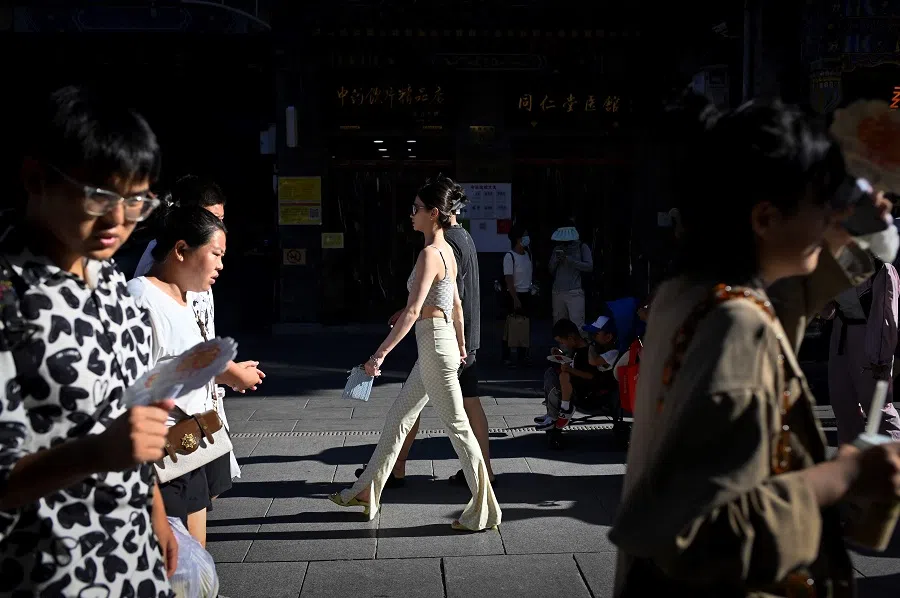
People visit a business street in Beijing on 22 August 2023. (Wang Zhao/AFP)
However, those familiar with the Chinese higher education system from the last century would know of the strict delineation between the humanities and sciences - a Soviet-style practice - and the specialised college system, such as the steel and iron institute, mining institute, water resources and hydroelectric engineering institute, as well as medical education at the bachelor's level.
Hence, Chinese students with an engineering, agricultural or medical background have relatively little knowledge about humanities subjects such as social sciences, history and religion, or even social issues such as social justice or multiculturalism, compared with American students with a similar educational background.
When faced with the impacts of American culture, they would readily withdraw to a "spiritually safe area", defending their hard-earned privileged status, which is a result of academic excellence and law-abiding behaviour. They do not want "illegal immigrants" to disrupt their lives and their ideal picture of society, nor do they want their children's employment opportunities to be eroded by legal immigrants.
They cannot bear with the idea that other minorities can be accepted into good schools because of factors outside of academic excellence. Furthermore, they do not want their children to be "corrupted" by any non-mainstream gender pluralism; nor do they want their children to be concerned with abstract topics such as "social justice" and "environmental protection".
I believe that such a perspective on life places too much emphasis on self-interest and is exceedingly dull and pallid.
... they want their children to have the prestige associated with an education from brand-name schools, while at the same time, they want their children to keep a distance from the ideas propagated in the classes of those schools.
Only for the prestige?
And yet, the staunch conservatism of first-generation Chinese immigrants is in itself contradictory. On the one hand, they have great admiration for the famed educational institutions in the US, and fight hard to secure the rights of their children to attend these schools. Yet on the other hand, they cannot fathom that the same institutions are in the hands of the baizuo they scoff at.
Tertiary institutions, especially the prestigious schools, have always been crucial strongholds for progressives in US society to counter right-wing conservatives. In today's America, it is nearly impossible to find a top institution that does not discuss multiculturalism, racism, environmental protection and gender diversity.
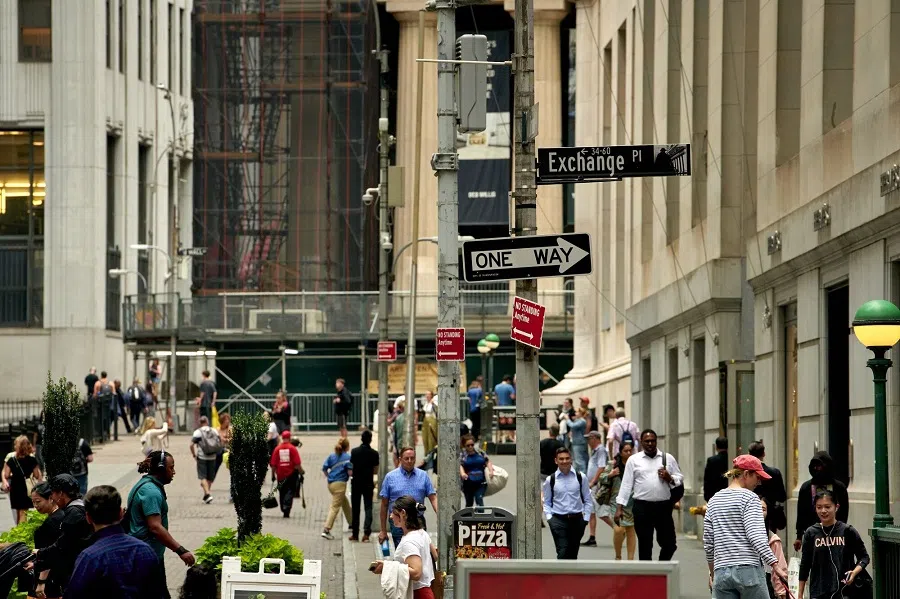
Pedestrians near the New York Stock Exchange in New York, US, on 28 August 2023. (Gabby Jones/Bloomberg)
First-generation Chinese immigrants do not exactly have a well-rounded knowledge about the way of the world; they want their children to have the prestige associated with an education from brand-name schools, while at the same time, they want their children to keep a distance from the ideas propagated in the classes of those schools. This is a laughable notion; it is no wonder liberals in the US struggle to understand them.
I believe that only second-generation Chinese immigrants, those who went through elementary and middle school education in the US and subsequently become college educated, would have a comprehensive understanding of US society and culture. Only then can the Chinese immigrants truly integrate into US society.
Are polar bears more important than security?
I believe that the attitude and stance adopted by the baizuo acts as an important counterbalance to the deep-rooted protectionism and populism in the US. They also help college students to widen their horizons and develop their social and environmental consciousness and to a certain degree, their sense of empathy.
But in real life, the baizuo can be radical in some aspects. For example, in the college curriculum, communication modules are hampered by overly politicised social and racial issues; classes for English majors analyse every text according to the three sociological lenses of class, gender and race; and history classes tend to lean towards excessive denigration of US history.
Because white progressivism inherently has elitist leanings, it tends to neglect the average person's life, safety and other fundamental interests. Indeed, detractors would ask: are polar bears more important than the safety and security of the people?
My sister, who initially leaned towards the liberal left, faced some challenges while living in Melbourne. Parents were left exasperated as changing one's gender identity became in vogue with middle school students, who would do so at the drop of a hat.
While I am in favour of protecting the legal rights and dignity of the LGBTQ+ community, I hope that this applies only after these individuals have affirmed their identity. I do not agree with adults and educational organisations overly promoting and glamourising issues such as homosexuality, bisexuality and transgenderism to youths at a tender age, or in any way encouraging or enticing them to think in this direction.
The first day of school for about one million students in New York City on 7 September 2023. (Bing Guan/Bloomberg)
If the baizuo has a grand picture of the world, and pursues a set of goals that will spur social progress under the banner of social justice, then they should rationally concede that the gender issue is not the sole problem of humanity, and gender diversity is ultimately an addendum to mainstream gender norms.
If all attention, especially the interest of adolescents, is directed to focus on an ever-changing sexual orientation, then the baizuo has indeed gone off the deep end.
Note from the writer: I would like to thank the American reader for her correspondence, my elder sister Rong Wu and Professor Fang Kecheng, for his longstanding interest on the issue of the baizuo and his groundbreaking research on it.
Related: Fewer Chinese academics in the US will worsen US-China disconnect | US academic: Equality is a myth, whether in the US or China | Is America falling apart? | Why do Chinese and Indian Americans stay silent during the US anti-racism protests?
I hope you enjoyed that take, even if you did not agree with every word.
Personally, I separate sexuality from gender identity, but I share the sentiment that neither should be glamorized in schools. I also strongly disagree with the claim that the left is “globalist,” a term that has historically been reserved for Jews by figures like Alex Jones. The left is seemingly “America First,” at least when threatened by Soviets or Islamists.
The left is increasingly willing to turn on its allies. Baizuo are the naive, easily corrupted.
Update: In 2026, I remembered this article, and it turns out I was very right about the left not being globalist. It took barely a month after publication for large parts of the left to insist that the US’ closest ally, one that contributes enormously to their IP, GDP, and healthcare innovation, is Satan. Over the following years, the left turned on allies and enemies alike. IMO, the Ukraine protests briefly gave the author an illusion that the left would consistently defend progressive values. It’s more accurate to say they defend whatever position happens to be popular.