Repost: IrishCentral, “Ireland banned Casablanca as unfair to Nazis”
I love the Irish. North and South. Doesn’t matter, both are hilarious. Both have contagious accents. Both think they’re the real Ireland. Both think they’re anti-imperialists while belonging to larger federations.
Ireland has a proud tradition of feigning neutrality to avoid fighting, which people like to compare to Switzerland. People can say whatever. They’re “neutral,” except for the part where imagined threats of diversity seemed far more alarming than mass executions across the Channel. Their “neturality” helps explain why Ireland remains one of the whitest countries on Earth, heavily reliant on banking and tax loop holes. In my B+ historical accounting, sending condolences to Germany at the end of World War II, mourning Hitler, was choosing a side. And if you accept that the Irish were, for the most part, Nazi simps, a lot of their modern behavior clicks. Like interrupting weekly anti-immigration protests to passionately defend “Free Free Publicity!” Whats that? “Free Free Publicity!” Pay attention to me!
There is something objectively funny about a divided island, one side Protestant, the other Catholic, both over 92% white, confidently explaining to Jews what an apartheid ethnostate looks like. But this isn’t my Jude blog, where I used the Irish to parody “the great noticing” so many Irish partake in… so I’ll leave it at that.
Enter this article: Ireland banned Casablanca because neutrality meant not offending the Nazis. The piece is by IrishCentral, a diaspora-focused outlet that blends Irish history, opinion, and cultural nostalgia for readers abroad, especially in the U.S. The article walks through how censorship, wartime politics, and selective outrage shaped the ban, and how “neutrality” often functioned less as principle and more as convenient silence.
Read it below, or read it on their site: https://www.irishcentral.com/opinion/niallodowd/casablanca-ban-ireland
The "Casablanca" ban in Ireland was a strange one and came down to Ireland's neutrality during World War II.
When Ireland banned "Casablanca" as unfair to Nazis
Niall O'Dowd; Jul 05, 2022
The "Casablanca" ban in Ireland was a strange one and came down to treating Nazis equally to the Allies.
The decision by the Irish government, in 2019, to ban the viciously anti-gay campaigner Steven Anderson was the correct one given his hate speech. At the time, the banning recalled some famous or infamous decisions made by Irish censors over the years.
Ironically, the man who banned Anderson was Justice Minister Charlie Flanagan, whose own father, Oliver J. Flanagan, was once a controversial politician widely known for anti-Semitism.
When he was elected to the Dáil in 1943, his first speech infamously promised to “rout the Jews out of this country.”
He clearly held Nazi sympathies. In another speech, he remarked: “There is one thing that Germany did, and that was to rout the Jews out of their country. Until we rout the Jews out of this country it does not matter a hair's breadth what orders you make. Where the bees are there is the honey, and where the Jews are there is the money.”
Incredibly, his ranting did him no harm politically and he was Minister for Defense for a time.
In fairness, his son Charlie Flanagan is widely known as a moderate progressive politician, who shares none of his father’s rabid convictions.
Perhaps Oliver J’s most infamous quote is “There was no sex in Ireland before television,” which has gone down in the history books.
But before Ireland becomes too congratulatory about itself, it is interesting to see what books and films they banned themselves.
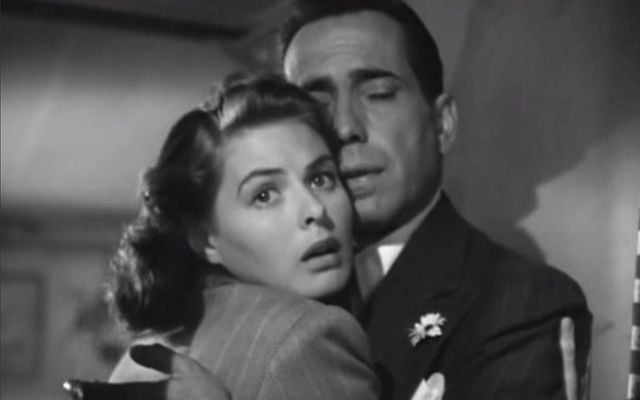
The most infamous banning was of the classic “Casablanca” in 1942. Considered by many experts among the best films ever made, the officially neutral Ireland said it was Allied propaganda and felt sorry for the poor Nazis and how they were portrayed. It starred Humphrey Bogart as Rick and Ingrid Bergman as Ilsa.
It was banned on March 19, 1942, for infringing on the Emergency Powers Order (EPO), preserving wartime neutrality in the way it portrayed Vichy France and Nazi Germany in a "sinister light."
It was later passed with cuts on June 15, 1945, after the EPO was lifted – this time the cuts were to dialogue between Rick and Ilsa referring to their love affair. It seemed even talking about affairs was forbidden.
Amazingly, even in 1974, the people of Ireland had to be saved from “Casablanca.” The censor passed it with one cut on July 16, 1974. RTÉ had asked about showing the film on TV – it still required a dialogue cut to Ilsa expressing her love for Rick.
Needless to say, the film of Joyce’s Ulysses was also banned in 1967, mainly because of the Molly Bloom soliloquy which was deemed too pornographic for the tender ears of Irish filmgoers.
Perhaps the most bizarre banning was WWF wrestling which the censor in 2001 said showed ”gladiatorial bloodlust” and baying crowds.
Edna O’Brien had the temerity to write “The Country Girls” in 1960, dealing with young women and their sexual adventures and thoughts. The Irish establishment went wild and the book was banned.
As O’Brien remembered, “Unbeknownst to me, a heated correspondence passed between Archbishop McQuaid of the Dublin diocese, Charles Haughey, then a minister, and the Archbishop of Westminster Cathedral, all deeming it filth, a book which should not be allowed in any decent home. My poor mother was ashamed and had her own private battle with me. She erased with black ink any of the offending words, and the book was put in a bolster case and placed in an outhouse. So much for the glories of publication.”
The notion of Charles Haughey, a known womanizer and cheat, pontificating on the need for women to be chaste and pure almost goes beyond belief.
So the history of banning in Ireland isn't a proud one, recent banning excepted. Censorship went hand in hand with the church for generations and led to some very strange decisions indeed.
If you choose to comment, have some sympathy for the Irish. Currently, their President, Catherine Connolly, a far-left politician, may be one of the dumbest people to have ever lived. Connolly defended the IRA while insisting "violence was never justified," months before defending Hamas as “part of the civil society of Palestine.” Despite a Hamas sympathizing President, despite a history of Nazi-allyship, most Irish I encounter insist they are under a ZOG.
So when an Irish writer admits, “Hey, maybe we shouldn’t have banned Casablanca,” you know his editors were like, “Please, please talk about all the other stuff we banned. We can’t have the public know which side we were on.”