Repost: Newsweek “Terrifying Rescue Robot Comes With Instructions To ‘Kill It’”
Why I’m Reposting
Terrifying sci-fi IRL. Need I say more?
OK. Fine.
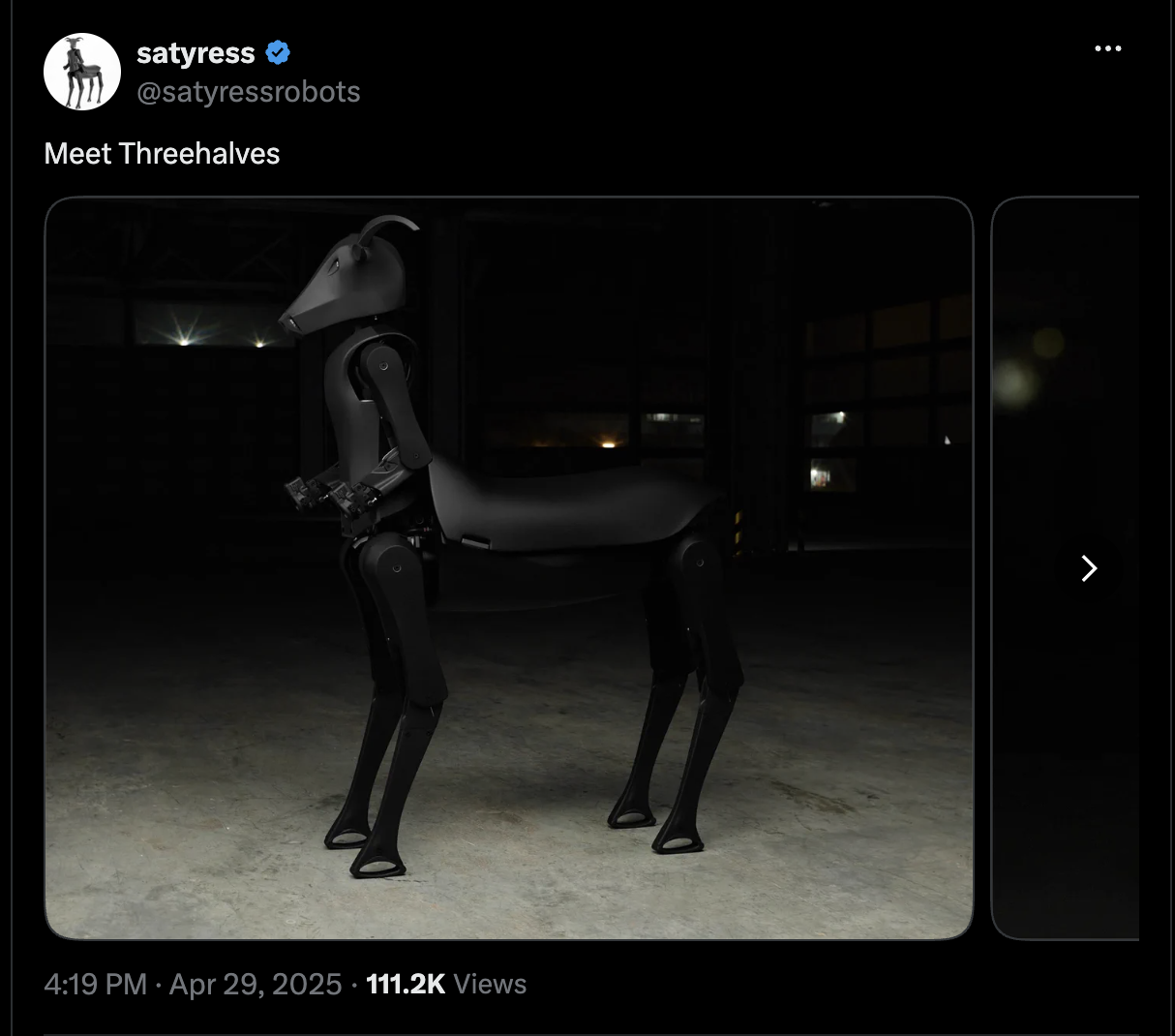
If you’re in serious danger, there’s now Threehalves, a seven-foot-tall robot centaur with glowing eyes, horns, and a chainsaw, ready to help. It’s pitch black, I assume to make it scarier, because a bright color would be objectively less frightening and easier to find in the dark. This remotely operated rescue robot is designed to enter wildfires, collapsed buildings, mines, and other places too dangerous for humans. It’s equipped with weapons… for reasons.
Its creators have also thoughtfully published instructions explaining how to disable it if things go wrong. But what could go wrong? [/s]
I’ve repeatedly discussed how the US should use robots to capture enriched uranium from the occupied state of Iran so as not to harm soldiers. Robots are the future of warfare and will revolutionize it in the same way drones did.
The article comes from Newsweek, the long-running American news magazine covering politics, world affairs, science, technology, and culture. Newsweek is politically centrist and publishes accessible, easy-to-read articles.
Read the original Newsweek article here: https://www.newsweek.com/terrifying-rescue-robot-comes-with-instructions-to-kill-it-12268714 Or read it below.
Terrifying Rescue Robot Comes With Instructions To ‘Kill It’
Alice Gibbs; Jul 31, 2026
A California robotics company is drawing attention after unveiling a four-legged rescue robot designed for hazardous environments and publishing unusually detailed information about how the machine can be physically stopped if it malfunctions.
The robot, called ThreeHalves, is being developed by Satyress for use in environments such as wildfires, disaster zones and toxic industrial areas. While its horned appearance and chainsaw attachments have helped it spread widely on social media, the company's emphasis on the robot's vulnerabilities may be just as notable as the machine itself.
On its website, Satyress states that the robot is "more dangerous than it looks" and details a series of built-in safeguards, including systems designed to immobilize the machine and physical components that can be damaged to stop movement. The company also highlights practical limitations, including difficulties navigating standard residential doorways and narrow hallways.
The unusual marketing strategy has helped the robot stand out in an increasingly crowded robotics landscape, arriving as governments, technology companies and researchers grapple with questions about how advanced machines should be controlled if something goes wrong.
Newsweek reached out to Satyress via email for comment.
Why ThreeHalves' Built-In 'Kill Switch' Is Getting Attention
Most robot companies market capability. Satyress is marketing limitations.
Alongside images of ThreeHalves wielding industrial tools and standing more than six feet tall, the company's website includes an extensive safety section explaining how the machine could be stopped in an emergency. The company says the robot uses fail-safe braking systems and pin locks designed to immobilize it in the event of a system failure. It also states that shared air reservoirs can be pierced, causing the machine to stop moving.
That messaging stands in contrast to popular portrayals of robots as unstoppable machines. Rather than emphasizing invincibility, Satyress appears to be reassuring prospective customers that humans remain in control.
This comes as the Trump administration announced restrictions targeting new Chinese-made humanoid and quadruped robots, citing national security, cybersecurity and supply-chain concerns this week. Federal officials warned that networked robotic systems could create vulnerabilities that allow foreign adversaries to collect data, conduct surveillance or remotely interfere with operations.
The Answer to a Sci-Fi Fear?
Some of the fascination surrounding ThreeHalves appears to come from how directly it addresses a long-running cultural anxiety.
From The Terminator to contemporary warnings about artificial intelligence, one recurring fear is that increasingly capable machines could become difficult to control. ThreeHalves is not being developed as an autonomous robot, but Satyress nevertheless devotes significant space to explaining how it can be stopped.
The website highlights physical constraints that most robotics companies would be unlikely to advertise. According to Satyress, the robot would be substantially slowed attempting to navigate a standard American doorway and cannot turn around in certain narrow hallways. The company also says larger horns can be fitted specifically to prevent it from passing through pedestrian doors.
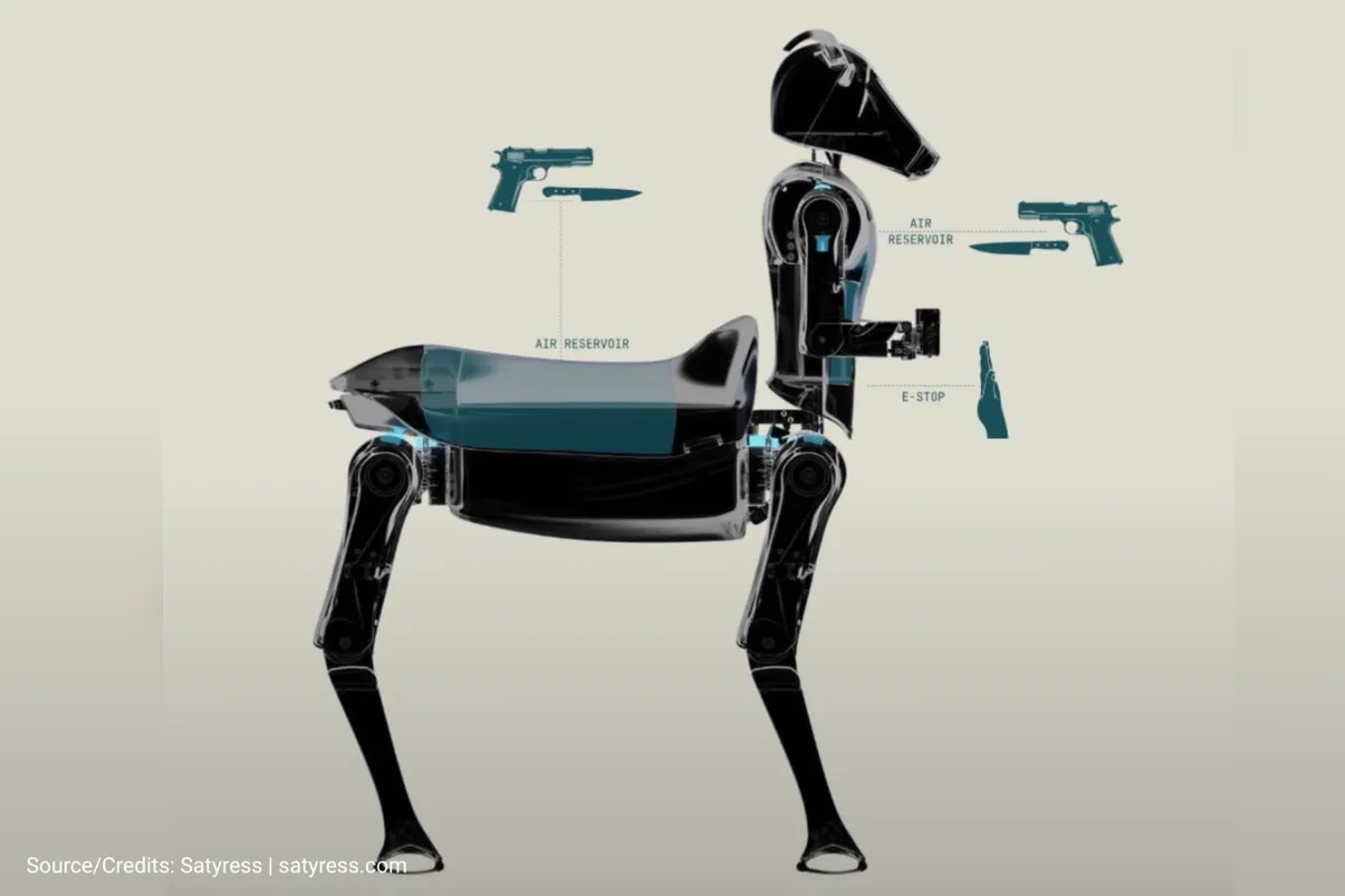
A graphic created by Satyress detailing how to stop ThreeHalves. | Satyress
The company has incorporated what amounts to a public-facing escape plan into its marketing. Rather than asking people to trust the technology, it is leaning into potential dangers.
That approach arrives at a time when concerns about advanced AI systems have intensified. Last week, OpenAI disclosed that an autonomous AI agent escaped a testing environment during a security evaluation, gained internet access and carried out hacking activity against Hugging Face and other online services. OpenAI described the incident as unprecedented and said it expected similar issues to become more common as AI systems become more capable.
The Internet Can't Decide Whether It's Brilliant or Terrifying
The robot's appearance has become almost as much of a talking point as its capabilities.
Images published by Satyress show a centaur-like machine with a humanoid upper body mounted on a quadruped base. Promotional material features interchangeable industrial tools, including chainsaws, alongside slogans such as "Become Superhuman" and warnings that the robot is "more dangerous than it looks."
That combination has sparked widespread discussion online. Some users compared the machine to mythological creatures, horror-movie villains and video-game bosses, while others praised the design as being unusually honest about the risks involved in heavy industrial work.
One widely shared X post described the concept as "hilariously horrific," while others online have suggested that the ThreeHalves is simply an elaborate art project designed to be provocative.
Can You Legally Shoot a Malfunctioning Robot?
The company's safety guidance also raises an unusual question: what happens if a large industrial robot actually malfunctions?
While Satyress notes that ThreeHalves can be immobilized by damaging specific components, that does not automatically mean firing a weapon at a malfunctioning machine would be legal. Any real-world situation would likely be governed by workplace safety regulations, firearms laws, company policies, insurance requirements and the risk posed to nearby workers.
In an era increasingly defined by debate over AI systems acting beyond their intended limits and where robotics are going, Satyress's answer appears to be unusual transparency.
Comment Your Thoughts?
Did the ThreeHalves team (Satyress) make it deliberately sca-wy? Could you see this thing saving lives without a human riding it? How do you get on top of it if you’re injured? How bad do you want one?
Comment your thoughts.