Dark & Vulgar Place Names
A short history of ridiculous place names, real and fake
The American slang BFE (Bum Fuck Egypt) predates the Argentine meme town Tero Violado (“Raped Lapwing”) by decades, but Spanish speakers beat Americans to ridiculous place names by centuries. We are blessed with endless names for The Boondocks, The Sticks, Timbuktu, or whatev you call your local one-horse town
Across Spain and Latin America, maps are filled with places whose translations might offend some. From Castrillo Matajudíos (“Kill-Jews Castle” or “Camp Kill Jews”) in Spain, to Venado Tuerto (“One-Eyed Deer”) in Argentina, to Negra Muerta (“Dead Black Woman”), I’ll discuss the history of real and fake place names, but especially Argentinian names that make you ask, “Argentina… ¿estás bien?”
Read ahead to get context for names like La concha de la lora (“the parrot’s vagina”), or just skim through the bolded names to get a cheap giggle.
Medieval Spain’s Disaster Naming
Between roughly the 10th and 15th centuries, villages were often named after events, battles, religious legends, or landscape features.
Unlike modern naming conventions, which tend toward neutral or commemorative names, medieval place names could be blunt descriptions of something memorable that happened there. Usually, dark things that happened there.
Here are some Spanish towns that may or may not still exist today. I didn’t bother to check.
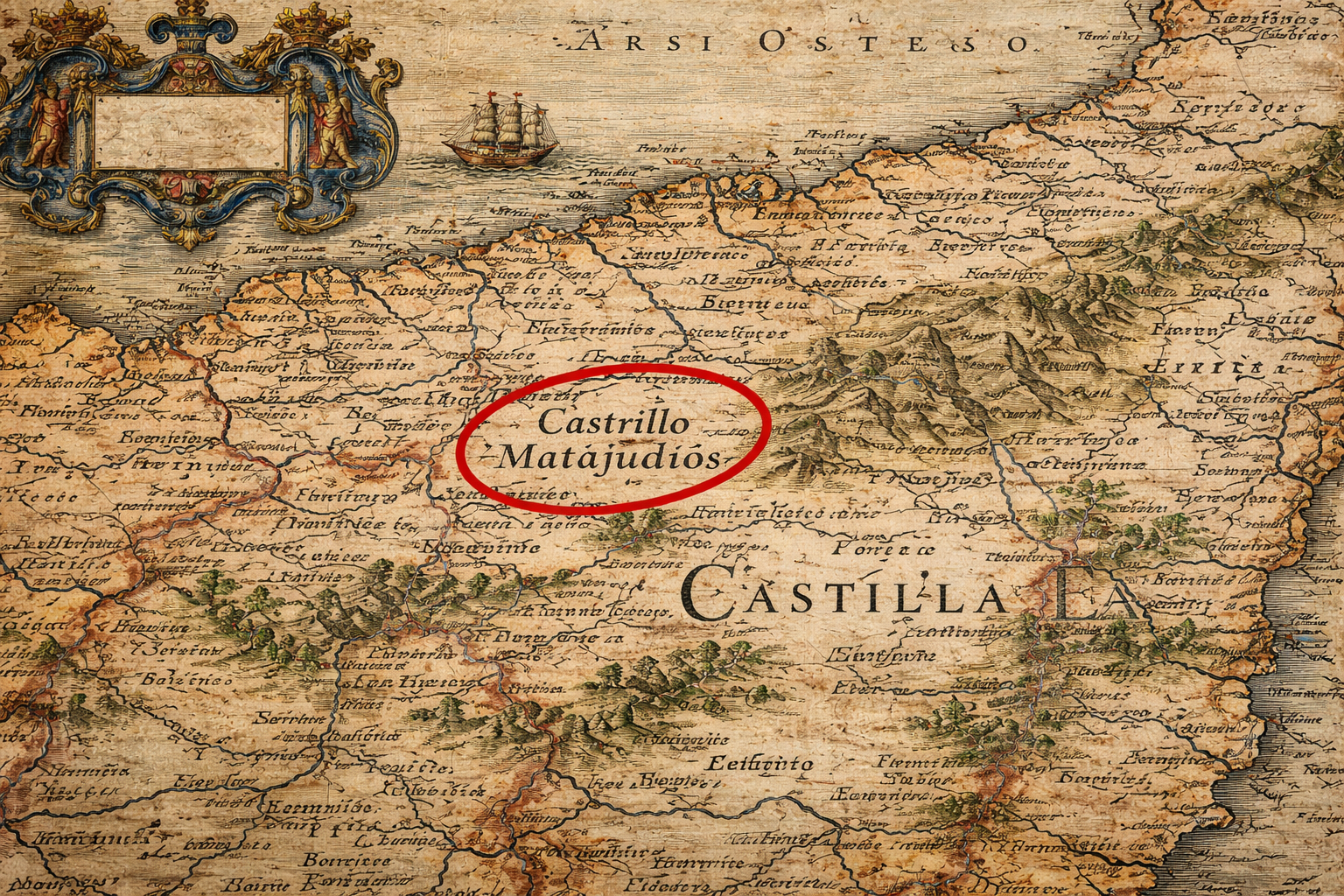
Castrillo Motajudíos —> Castrillo Matajudíos (Jew Hill Camp —> Kill-Jews Castle / Camp Kill Jews)
Matalascañas (Kill the scum)
Matamoros and Matamorosa (Moor killer)
Guarromán (Dirty Roman)
Villapene (Penis village)
Puerto del Infierno (Port of hell)
Valdeinfierno (Valley of hell)
Cerro del Muerto (Hill of the dead)
La Matanza (The massacre)
La Garganta del Diablo (Devil’s throat)
Malpartida (Bad departure)
Villanueva del Trabuco (New town of the blunderbuss (blunderbuss was a precursor to the shotgun))
I won’t get into each one, but I’ll get into Castrillo Matajudíos (“Kill-Jews Castle/Hill”), originally named Motajudíos in 1035, then changed to Matajudíos in 1627, then reverted (Castrillo Mota de Judíos) around 2014.
Like many towns that once had Jewish populations, the history of this town is grim. In 1492 the Spanish crown ordered Jews to convert to Catholicism or leave Spain. Jews were persecuted, expelled, or executed. The town’s names likely reflected the hostile atmosphere towards Jews during that period, first marking where Jews were, then that they were loyal and converted. Basically, "Don’t come here. We already got ‘em.”
Today, the renamed town Castrillo Mota de Judíos has around 50-100 residents, making it smaller than most of my University classes. But the history, and continued Nazi-supporting graffiti on this small town, is a pretty good reminder of why Spain still today goes out its way to demonize the Jewish state alone. [Not all Spaniards, but too many.]
Next up, you’ll see how the Spanish brought their naming conventions to the New World.

Maybe the One-Eyed Deer was cute??? You don’t know. (obvious ChatGPT image)
Colonial Latin America: Just As Dark, More Fire
During the Spanish colonial period (1500–1800), settlers carried the same descriptive naming habits to the Americas. Many settlements were named after: strange animal encounters, burned vegetation, local legends and dangerous landscape features.
Argentina, in particular, accumulated many names that sound dark when translated into English.
Venado Tuerto (One-eyed deer)
Monte Quemado (Burned mountain)
Palo Quemado (Burned stick)
Laguna del Diablo (Devil’s lagoon)
Boca del Diablo (Devil’s mouth)
Campo del Cielo (Field of heaven)
Paso de los Indios (Pass of the Indians)
Cueva del Tigre (Tiger cave)
El Hoyo (The hole)
While not pre-1800s, the city I grew up in was named Boca Raton (Mouth of the Rat/Mouse). So I guess these names just start to feel normal after a while, and you stop thinking about the direct translation. Boca Raton, btw, does not have a rat problem. It’s those damn Spaniards again, who used the term “Boca de Ratones” for a rocky, dangerous inlet. [Today, the beaches and inlets have a mix of original terrain and imported sand.]
Nineteenth-Century Settlements
Seriously, ¿estoy bien, Argentina?
During the expansion of rural settlements across Argentina in the 19th century, many of these descriptive names became official towns. Some of them sound even more macabre.
Negra Muerta (Dead Black Woman)
Bayo Muerto (Dead horse)
Sepultura (Grave)
Pozo Borrado (Erased well)
Zanja de la Viuda (Widow’s ditch)
Tres Esquinas (Three corners)
Laguna Brava (Fierce lagoon)
Sierra de la Vaca Muerta (Mountain of the dead cow)
El Molle Quemado (Burned molle tree)
El Quebrachal (Broken tree forest)
La Dormida (The sleeping woman)
Los Pozos (The wells)
Cerro Negro (Black hill)
La Angostura (The narrow place)
El Desengaño (The disappointment)
La Soledad (The loneliness)
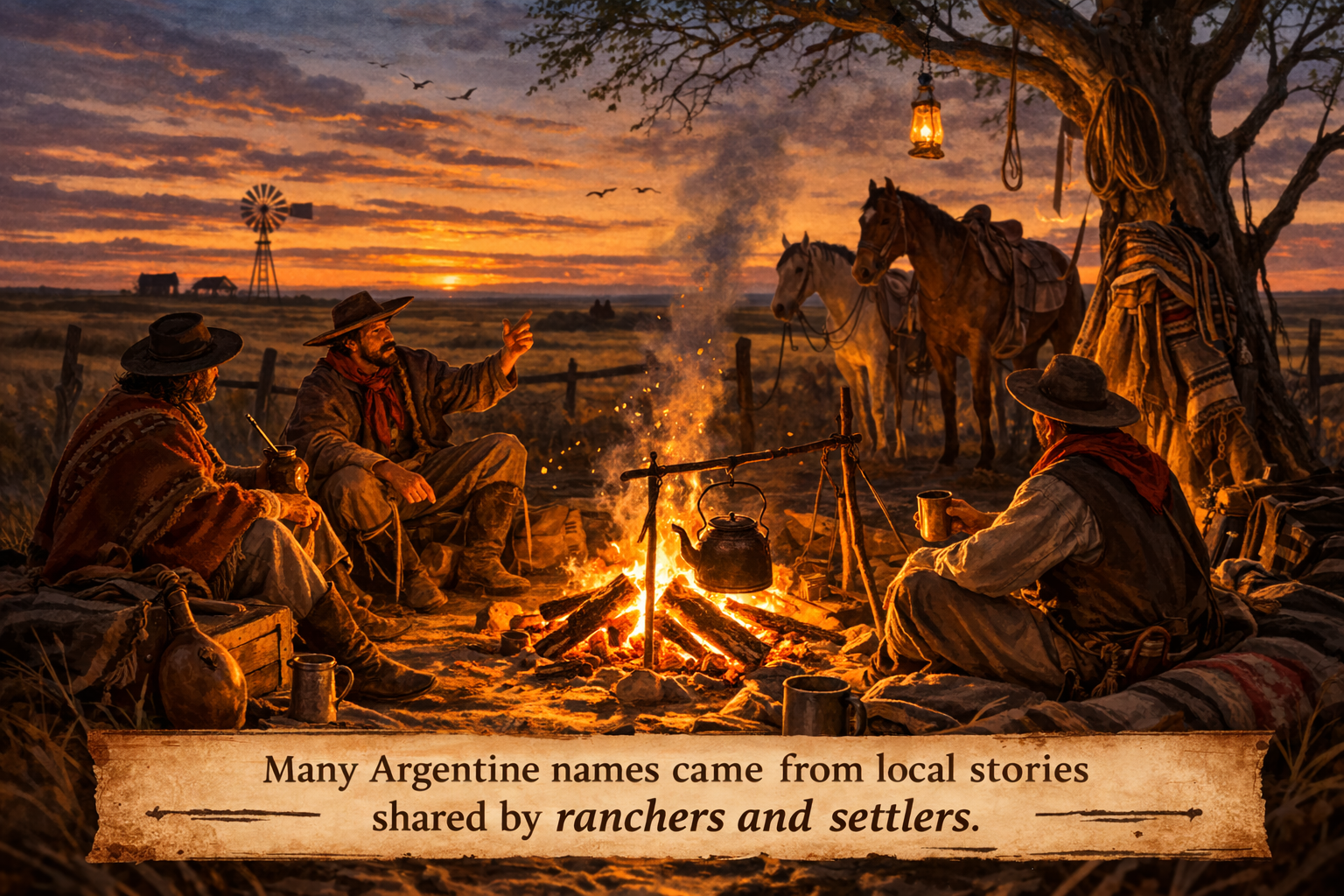
These names often came from local anecdotes, ranching stories, or geographic features, but the literal translations make them sound like crime scenes.
The 19th-century stories aren’t that deep, from what I’ve gathered. Take Negra Muerta: The story locals repeat is basically that the body of an Afro-Argentine woman was found there, so that’s the name they used. That’s it. You don’t see many Black Argentines today, and after talking with enough locals it’s clear that racism toward them exists.
Slang for the Middle of Nowhere
Long before internet memes, Spanish already had colorful expressions for remote places.
Argentina developed several phrases meaning “the middle of nowhere.”
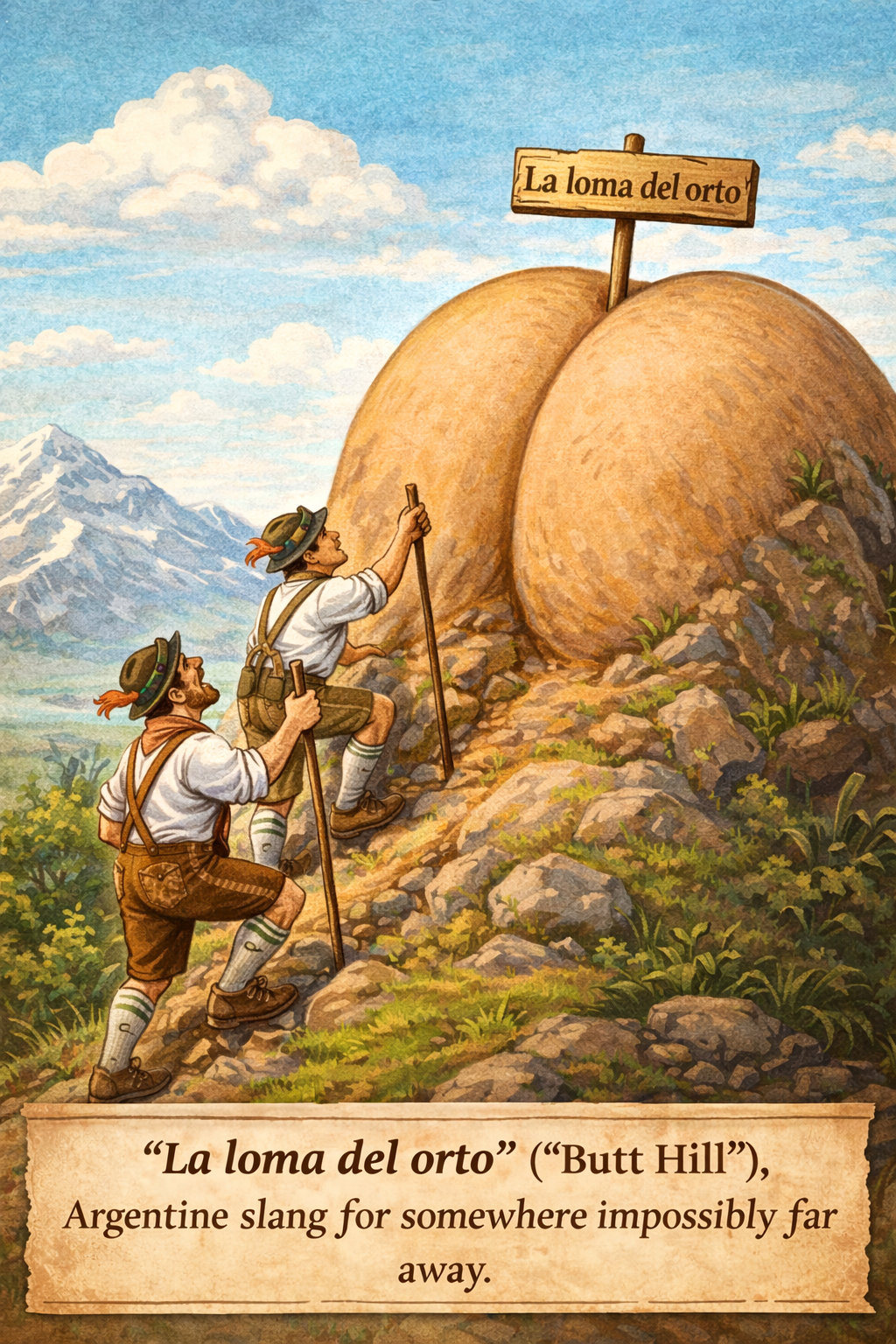
La loma del orto (Butt hill)
El culo del mundo (Ass of the world)
Donde Cristo perdió el poncho (Where Christ lost his poncho)
Donde El Diablo perdió el poncho (Where The Devil lost his poncho) (Side note: My Argentinian friends only heard this version, not ‘Donde Cristo,’ which appears to be more common. So I guess they’re all heathens?)
El quinto pino (The fifth pine tree)
La concha de la lora (The parrot’s vagina)
These expressions created the cultural foundation for later jokes about imaginary towns. It’s the type of humor that makes me think maybe Argentina will be OK.
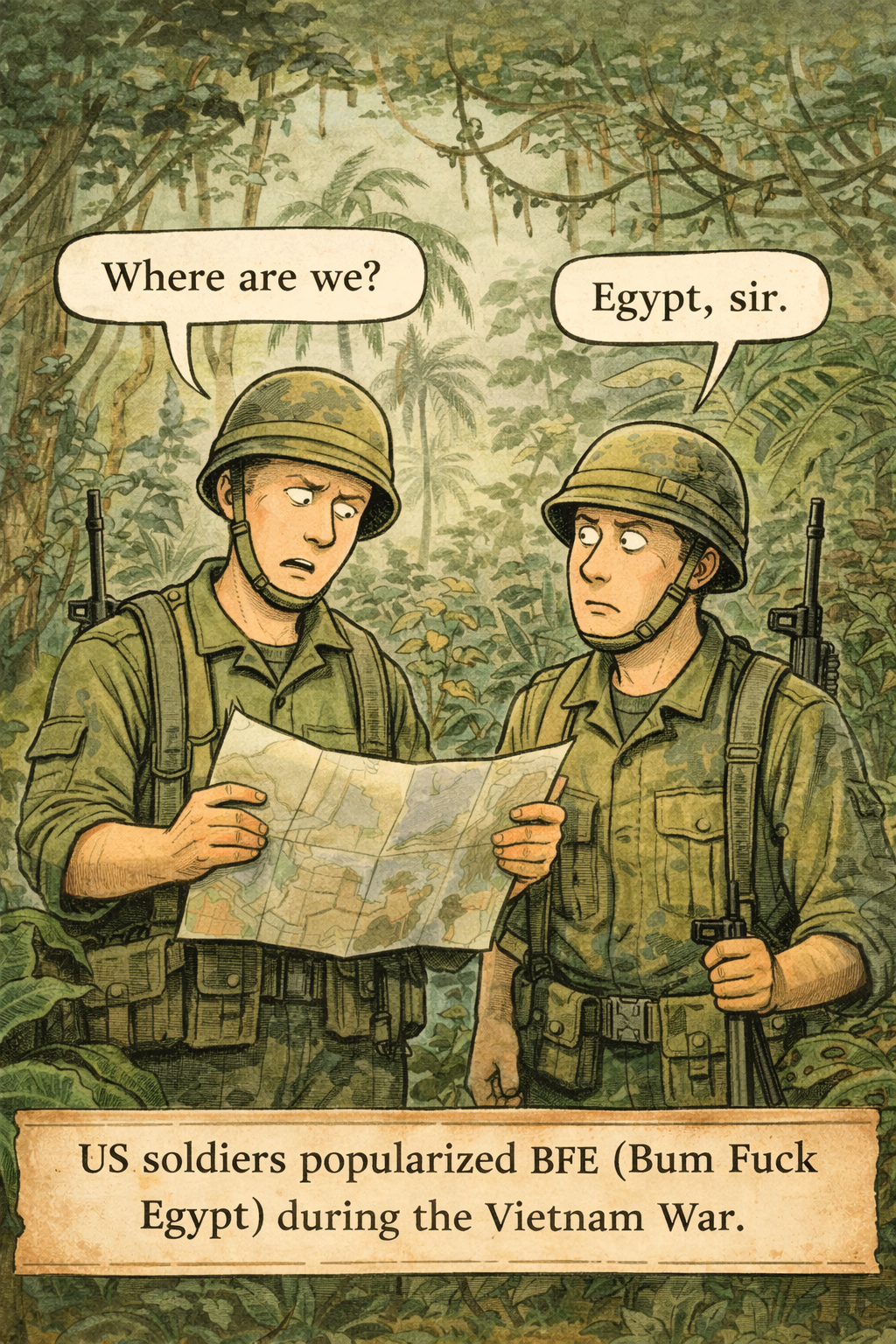
BFE: The USAmerican Term
Finally, let’s get to the term I use as a good ole US ‘Merican.
The phrase BFE (Bum Fuck Egypt) originated in United States military slang in the late 1960s and early 1970s, during the Vietnam War era. Soldiers used it to describe remote bases or postings located far from any major city.
Let me Guy-splain it. The phrase combines:
“bum fuck,” crude slang for an extremely remote place. Also, a cute way of saying “rape.”
“Egypt,” used metaphorically as a distant and unfamiliar location. Even though they were in Vietnam.
English speakers previously used far-off places like Timbuktu or Outer Mongolia as shorthand for somewhere impossibly remote. Today, I hear BFE most often, and I’m OK with that.
By the 1980s, the abbreviation BFE had spread into general American slang, making it a pre-internet meme.
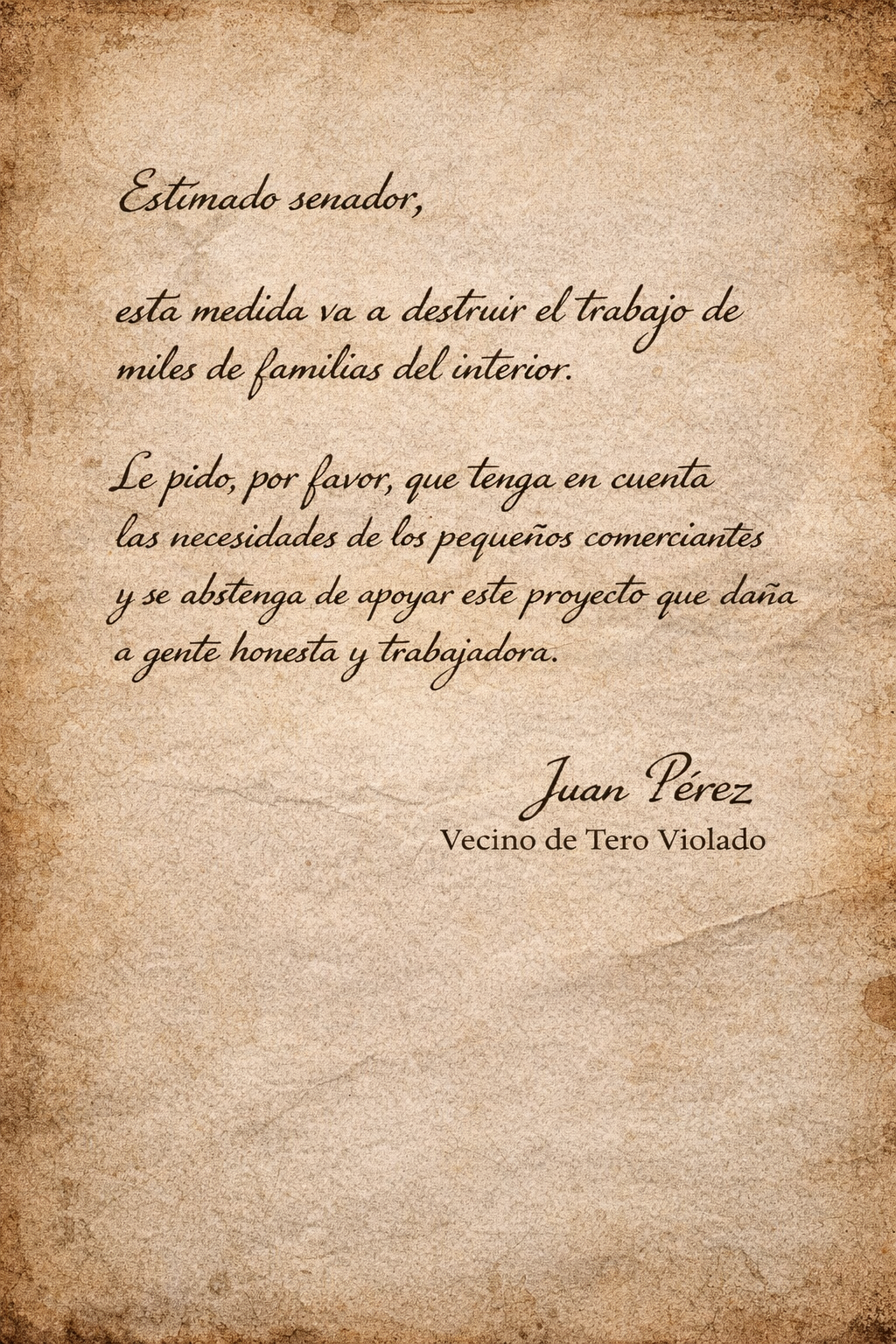
Since my español no es bueno it was hard to find a real example of this meme.
Meme Towns and Fictional Places
In the internet era, this tradition evolved into something new: fictional towns used in political memes.
My favorite meme town mirrors history and BFE.
Argentines with a sense of humor talk about Tero Violado (“Raped Lapwing”), a completely fictional town that began circulating online around 2022.
The meme usually appears as a serious political message followed by a signature line.
Imagine, fellow gringos:
Dear Senator,
The bill you are proposing will hurt small business owners. bla bla bla.Juan Pérez
Vecino de Tero Violado
The joke is the contrast between a formal political statement and the ridiculous town name.
It has even produced an imagined identity: Terinenses.
The name works because it sounds plausible. Argentina already has towns like Venado Tuerto (“One-Eyed Deer”) and Vaca Muerta (“Dead Cow”), so a place called Tero Violado almost fits.
The word tero refers to the Southern lapwing (Vanellus chilensis), a noisy ground bird common across Argentina and Uruguay. The bird is famous for loudly screaming at intruders and aggressively defending its nest.
The tero is also the national bird of Uruguay, which makes the absurdity of the name even more recognizable in the Río de la Plata region.
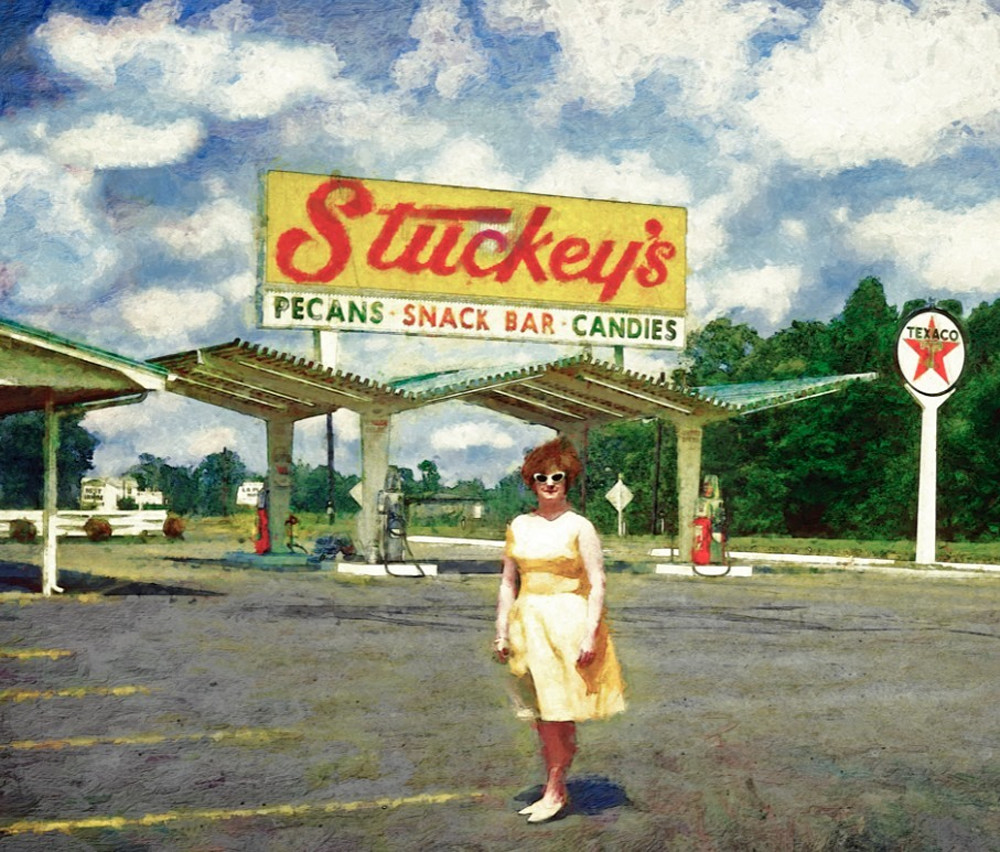
I know there used to be tons of Stuckey’s, but for South Floridians, the one in YEEEEEEEEEEEHAW JUNCTION (say it like “Leroy Jenkins!”) was iconic.
Image origin unknown, but found in a thrift store box with old Kodachrome images, taken from: https://www.fineartmarketplace.com/stuckeys-corporation/art_print_products/yeehaw-junction-painting
Around the World, Giggling Is Still Legal
Of course, the phenomenon of strange place names is not limited to Spanish-speaking countries. You can look up almost any place on Earth and find a funny name or two, either from the transliteration of an old language, or from the dark history, or for some other reason. Language evolves. Maybe a name that sound normal today, like Arkansas or Missouri, will sound funny in several centuries.
Come to think of it, some normal places already sound funny.
I grew up in Florida, where I loved stopping at Yeehaw Junction, the epitome of BFE: a place to fill up on gas, once buy discounted Disney tickets, and get your car completely covered in bugs.
Here’s some more funny names and explanations to end this article:
Accident, Maryland (possibly named after a surveying mishap)
Bat Cave, North Carolina (named after a nearby cave filled with bats)
Boring, Oregon (named after early settler William Boring)
Cape of Good Hope, South Africa (originally named Cape of Storms by Portuguese explorers)
Cut and Shoot, Texas (named after a frontier dispute)
Dead Horse, Alaska (named after a horse that died during construction)
Death Valley, California (named by pioneers after deadly travel conditions)
Dull, Scotland (possibly from Gaelic meaning meadow)
Fugging, Austria (formerly Fucking; named after a medieval family called Focko)
Hell, Michigan (named in the 19th century)
Hell, Norway (from Old Norse hellir, meaning overhang or cave)
Intercourse, Pennsylvania (likely from an old word meaning social interaction)
Kill Devil Hills, North Carolina (possibly named after rum strong enough to “kill the devil”)
Middelfart, Denmark (middle crossing; from Old Danish melfar)
Mount Doom, New Zealand (Mount Ngauruhoe, used in Lord of the Rings filming)
Rottenegg, Germany (rotten corner or ruined ridge)
Shitterton, England (farm by a sewer stream; from Old English scitte meaning sewage)
Skeleton Coast, Namibia (named for shipwrecks and whale bones along the shore)
Skull Creek, Nebraska (named after a massacre during frontier conflicts)
Suicide Cliff, Saipan (WWII site where Japanese civilians and soldiers jumped during the Battle of Saipan)
Taklamakan Desert (often interpreted as “you go in, you don’t come out”)
Truth or Consequences, New Mexico (renamed after a radio show)
What’s Your Favorite?
I could try turning this into a BuzzFeed-style quiz next, but knowing myself, I’ll move on to the next topic and forget I wrote this (edited and fact checked by ChatGPT).
So if you know a dark, vulgar, or otherwise funny place name, leave it in the comments. That’ll remind me this exists. And if you can, give a little background for those of us still immaturely laughing at Lake Titicaca well into adulthood.