Marx on Jerusalem
As a follow up to my repost of Emma Goldman, "On Zionism", I touch on famously self-hating, atheist Jew, Karl Marx. For those too lazy to read ~1 page, I am not suggesting Marx was a Zionist like Emma Goldman, only that he should have been, and that his writings point to Jewish ties to Jerusalem and suffering under Islamic rule.
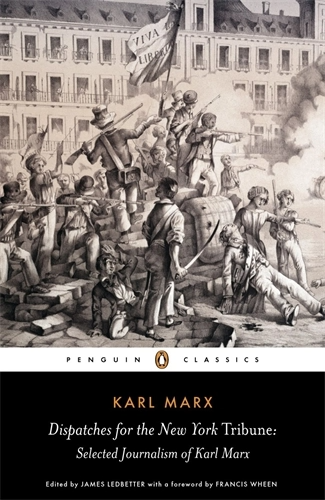
In an 1854 article written for the New-York Daily Tribune, Karl Marx described Jewish life in Jerusalem under Ottoman Islamic rule. The article predates the term Zionism, predates many pogroms, and long predates the Shoah and Farhud. Yet Marx was already aware that Jewish history was marked by repeated persecution, from medieval expulsions and the Inquisition to earlier massacres and legal discrimination worldwide. His writing reflects that awareness of Jewish persecution in their homeland under Islam.
Reporting during the Crimean War, Marx examined Jerusalem as part of a broader critique of the Ottoman Empire and its management of religious minorities. He described the Jewish population as systematically mistreated. He wrote, “Nothing equals the misery and the sufferings of the Jews at Jerusalem, inhabiting the most filthy quarter of the town, called Hareth-el-Yahoud — the constant objects of Mussulman oppression and intolerance, insulted by the Greeks, persecuted by the Latins, and living only upon the scanty alms transmitted by their European brethren.”
Marx did not support Judaism or Jewish nationalism. Marx recognized Jews lived in Jerusalem as a distinct and longstanding community, and their suffering was structural rather than accidental. Marx did not describe Jews as newcomers or interlopers. Their vulnerability was treated as a consequence of political powerlessness. The misery he recorded was the predictable outcome of life as a tolerated but unprotected minority.
That recognition exposes Palestinian political movements as anti-indigenous. Every major articulation of Palestinian statehood has rejected Jewish rights in the territory. The Hamas charter explicitly calls for the slaughter of Jews worldwide. The most moderate Palestinian institutions, such as the PA, refuse to recognize Jews as an indigenous people with rights in the land. Jewish history in Jerusalem, which Marx treated as obvious and continuous, is denied across Palestinian political discourse. Palestinianism functions not as an anti-colonial movement. It erases indigenous populations.
Marx himself was deeply hostile to religion. In writings, such as On the Jewish Question, he employed antisemitic tropes. His sympathy for Jewish suffering in Jerusalem did not translate into support for Jewish autonomy. We should also not single out Jews as the only victims of Ottoman Islamic rule; Armenians, Greeks, Assyrians, and others suffered under the same imperial system. Marx’s lens was materialist, not moral, and his focus was on how Ottoman Islamic rule harmed minorities broadly.
This is precisely where his Jerusalem account remains relevant. Long before modern Zionism, and long before the twentieth century’s catastrophes, Marx documented a simple reality: Jews lived in Jerusalem, and they lived there without safety, rights, or security. Secular Zionists, including figures such as Emma Goldman, rejected religion just as fiercely as Marx did, but drew a different conclusion. For them, Jewish survival required self-determination, productive labor, and control over material conditions.
Marx did not anticipate that solution. But he identified the problem.
Marx’s writing remains uncomfortable for modern narratives: a man hostile toward Judaism nonetheless acknowledged that Jews had a continuous presence in Jerusalem, and that Ottoman Islamic rule persecuted Jews and other minorities.