Repost: The Spectator, “Why is el-Fattah's return a 'top priority' for Starmer?”
tl;dr Jonathan Sacerdoti, “When ministers proudly proclaim that they worked tirelessly to bring home a man whose own words include calls to kill civilians, observers notice.”
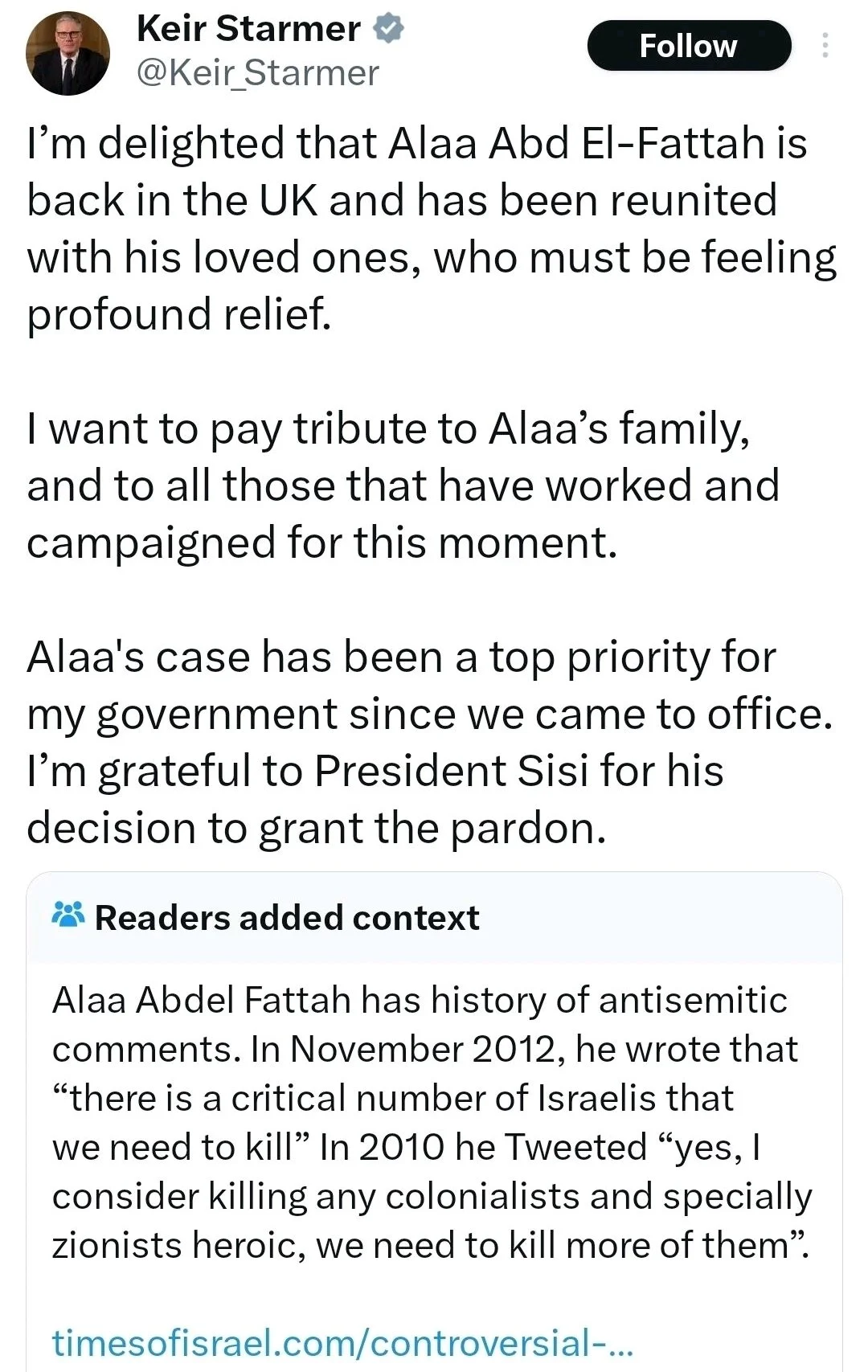
Is Keir Starmer’s base UK citizens, or the online mob he’s entertaining despite their calls to murder UK citizens?
For the non-terminally online, there is a term called the “dirtbag left,” reserved for those who are left in name only. I call them scumbags. This crowd brands itself as enlightened, progressive and humane while constantly proving the opposite. They scream “fascism” and “Nazi” at anyone with different views, openly celebrate extremism abroad and terrorism at home, and twist “liberal values” into applause for societies that institutionalize religious authoritarianism.
Under this worldview, “Free Palestine” has evolved from a political stance into a social credential system — a moral performance badge that automatically confers virtue and elite approval. In that environment, violent rhetoric against Israel is validating. This story is a textbook case: a foreign-born figure elevated into a public policy priority not because of contribution, but because his hostility toward Jewish civilians aligns with fashionable ideological expectations.
Meanwhile, millions of legitimate asylum seekers who don’t support violence remain bureaucratically invisible.
Alaa Abd el-Fattah — alongside figures like clown Bassem Youssef — exemplifies the so-called red–green alliance. And yes, red plus green equals brown. Both come from Egypt, a society defined by Islamic imperialism, political imprisonment, gender apartheid, and routine violation of civil liberties. Instead of leading neccessary conversations about the systems that actually destroyed their lives, they direct their activism entirely toward demonizing Jews. In their faux-progressive culture that is the most rewarded position they can take. It is like a person escaping an abusive family, embraced by a new one, and deciding that the only story worth telling is a fabricated attack on the people who sheltered them. The policy consequence of this dynamic is obvious: it incentivizes grievance theater over reform advocacy, propaganda over accountability, and selective outrage over principled liberalism.
The post shows how Keir Starmer’s government chose to treat Abd el-Fattah’s return as a triumph, despite his stated contempt toward Britain (and Jews, Israelis, Americans and civilians in general). It scrutinizes how his citizenship was acquired as a strategic instrument rather than through integration or demonstrated respect for democratic norms. Even more damning, it contrasts that enthusiasm with the government’s restrained posture toward British victims of Hamas terror, raising an unavoidable policy question: which values actually drive British diplomatic urgency?
If citizenship requires no civic loyalty test, if democratic values are no longer culturally defended, and if violent rhetoric is excused so long as it flatters elite narratives, then Britain is not just virtue signaling — it is actively redistributing legitimacy toward people who oppose its principles. How long can that last?
It also makes you wonder why Egypt is an ally state, especially one which the UK (and US) donate heavily to, in between the West demanding their citizens leave the allied state. Doesn’t really seem like a great ally. If we go back to the abusive family analogy, it’s like donating money to the abusers so that their victims can criticize their rescuers.
“Why is Alaa Abd el-Fattah’s return a ‘top priority’ for Keir Starmer?” in The Spectator is a sharp examination of how the UK government wrapped public resources, diplomatic capital, and moral urgency around an openly extremist figure, and what that signals to allies and enemie alike. Check out Jonathan Sacerdoti’s other work.
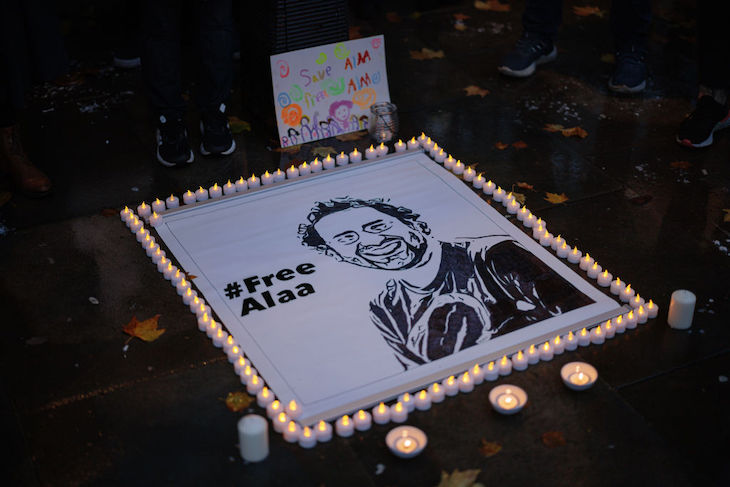
Supporters of Alaa Abd el-Fattah gather outside Downing Street (Getty images)
Why is Alaa Abd el-Fattah's return a 'top priority' for Keir Starmer?
Jonathan Sacerdoti; 27 December 2025, 8:57pm
Apparently it has been a “top priority” for Keir Starmer and his government, since the moment they came to office, to return Alaa Abd el-Fattah to the United Kingdom. A man granted British citizenship only in December 2021. A man who had previously described Britons as “british dogs and monkeys”, who wrote that he “rejoice[s] when US soldiers are killed, and support[s] killing zionists even civilians”, and who declared, without equivocation, “I’m a violent person who advocated the killing of all zionists including civilians, so fuck of [sic]”. Top priority.
The Prime Minister’s enthusiasm was echoed in chorus. Yvette Cooper expressed her ‘delight’. Hamish Falconer assured the world that ‘the British government is unwavering in its commitment to supporting British nationals around the world’. The tone was gushing, unguarded, congratulatory. The political message was unmistakable.
The mechanics of his British citizenship matter, because they expose how thin the connection really is. Alaa Abd el-Fattah was not born in Britain, raised in Britain, educated in Britain, or formed politically in Britain. He acquired British citizenship only in December 2021, while sitting in an Egyptian prison, through a registration process based on descent from his mother, Laila Soueif, who was born in London and retained British nationality.
That passport was granted with his views already unmistakable. Alaa Abd el-Fattah had declared in Arabic in 2012: ‘Palestine is Arab…The Jews have a right to stay once they are tried for their crimes,’ framing Jewish presence as conditional on collective punishment. Responding that same year to a post about Hitler, he wrote: ‘The Jews were also Hitler’s people, and he killed many of his people by the way.’ Elsewhere he removed any doubt about intent, describing himself plainly as ‘a violent person who advocated the killing of all zionists including civilians.’
This was not a naturalisation grounded in residence, integration, or demonstrated cultural attachment to the country. It was a legal inheritance activated for strategic reasons. His family pursued British registration explicitly to secure consular leverage, international attention, and diplomatic pressure while he remained incarcerated. The Home Office accepted the application. The status was conferred. From that moment, the British state chose to treat him as one of its own.
That choice was lawful. But it seems that at no point did the process require any assessment of his published views about Britain, Britons, Jews, Americans, or the legitimacy of violence against civilians. No test of values. No expectation of allegiance. Citizenship arrived fully formed, detached from conduct, language, or loyalty.
This distinction undercuts the moral shorthand now being deployed. Abd el-Fattah did not return to a country he had genuinely contributed to or appears to love. Ours is a country whose passport he had obtained four years earlier, long after his public record was already established, and whose people he had vilified in his own words. That context does not invalidate his legal status. It does, however, sharpen the question of why his return was elevated into a defining triumph of government purpose.
Contrast, then, the language reserved for Emily Damari. Damari, a British-Israeli dual national abducted from her home by Hamas on 7 October 2023, endured more than fifteen months of captivity. She was injured, hidden, deprived, used as a bargaining chip by a terror organisation whose methods included mass murder, rape and hostage-taking. Her Britishness was neither recent nor merely instrumental. She is British through her mother, culturally immersed, publicly affectionate towards the country, a familiar presence among friends, family and community here long before her abduction forced her into international view.
When Damari was finally released in January 2025, the Prime Minister welcomed the news with a formal statement. He described it as ‘wonderful and long-overdue’. He thanked the Israeli government. He called for the release of remaining hostages. All appropriate. All restrained. There was no suggestion that securing her freedom had ranked as the defining priority of his government, despite Falconer’s ‘unwavering’ commitment to support British nationals.
The asymmetry is telling. Both individuals hold British citizenship through their mothers. But the similarities end there. Abd el-Fattah’s public record includes repeated endorsements of violence, explicit celebration of killing civilians, and language of collective hatred aimed at Jews, Israelis, Americans and Britons. Damari’s public record contains none of this. She was taken because she existed. She survived because others negotiated. She returned because pressure was applied elsewhere.
Indeed, Starmer’s most memorable intervention on the hostage crisis remains his conference speech calling for the return of the ‘sausages’. The slip was clumsy. The moment lingered. For many watching, especially Jewish families, it landed as carelessness in the presence of trauma. While Britain did contribute limited surveillance assistance in the skies over the Gaza Strip, diplomatically, its footprint was faint and eventually negative. The decisive pressure that broke the logjam came from Donald Trump and Benjamin Netanyahu, who leaned hard on Qatar to force movement. London was not central to that effort.
At the same time, Starmer’s government chose to advance recognition of a make-believe Palestinian state during an active war and live hostage negotiations, without conditions on Palestinian actors and with explicit demands placed only on Israel. The practical consequence was predictable. Recognition, announced in that context, created incentives for delay and made hostage release less urgent for those holding the captives.
This risk was spelled out plainly by Marco Rubio: ‘We told all these countries, we told them all, we said if you guys do this recognition stuff it’s all fake, it’s not even real, if you do it you’re going to create problems…it’s going to make it harder to get a ceasefire’. Those words framed a choice that the British government enthusiastically and publicly made. The return of a British hostage was evidently subordinate to symbolic diplomacy and dodgy moral signalling. Diplomatic priority reveals itself through actions, sequencing and consequence.
This returns us to first principles. Governments communicate not only through action, but through emphasis. When ministers proudly proclaim that they worked tirelessly to bring home a man whose own words include calls to kill civilians, observers notice. Other Arabs notice. Other activists notice. Islamists notice. Criminal networks notice. Britons notice. British Jews notice.
The picture that emerges is alarming. A government eager to celebrate its efforts on behalf of a man who had shown open contempt for the country and advocated violence against entire groups. A government markedly less animated when a British woman was dragged from her home, held underground, and traded between gunmen.
States teach lessons even when they do not intend to. Here the lesson is plain enough. Britain will strain publicly for some causes and murmur for others. Citizenship, decency, cultural belonging and moral clarity no longer align reliably with urgency. Others who wish to enter this country with extreme views will read the signals carefully. So will those who wonder whether their government sees them clearly when the cost of indifference becomes unbearable.
Britain has chosen to wrap state protection and moral urgency around a man who celebrated the killing of civilians, called for the murder of Jews, and spoke of Britons with open contempt. That decision is reckless, corrosive, and instructive in the worst way, because it teaches that hatred carries no lasting consequence once the passport is secured.
What do you think? Cause I’m sure the “political message” here is that Jews should get out of UK immediately.