Repost: Washington Free Beacon, “Times Columnist Kristof’s Father Fought on Nazi Side in World War II”
Free Palestine activism is famously good at DARVO: Deny, Attack, and Reverse Victim and Offender. One tactic it uses with great results is getting ahead of the horrible things Palestinians actually do, like using their own children as suicide bombers, by endlessly repeating false accusations about Israel and Israeli supporters instead.
This month’s DARVO campaign became especially obvious as stories began piling up about Palestinian victims of rape. That includes documented testimonies from women in Gaza raped by Palestinian men, alongside an extensive report detailing the sexual violence committed on October 7 by Palestinians, not limited to Hamas.
Remember, nothing screams “Free Palestine” more than immediately deflecting whenever Palestinians are held responsible for anything they do. This activism is rarely about holding Hamas or Palestinian society accountable. It is about blaming the Other, which you can define as Jews or Zionists if you prefer.
First came the puff pieces from CNN and other Free Palestine-leaning journalists, the type who think truth is relative and treat “lying for the cause” as a journalistic duty. Naturally, many of those pieces conveniently left out the brawl at the end of the wedding celebration that was caught on film. Instead, readers were told that mass weddings in Gaza, including cases involving women whose ability to consent is questionable, were acts of resistance against Israeli apartheid. Yes, even marriage ceremonies in the Middle East now need to be framed as anti-Israel activism to matter.
Two “My Big Fat Palestinian-Not-Arab Weddings” were barely moving the needle from pieces reminding people that child marriages are still a serious issue in Gaza, and having six kids in poverty isn’t resistance as much as it is Idiocracy.
So New York Times columnist Nicholas Kristof decided to do his part in “Freeing Palestine.”
He covered the reports about Palestinian women being raped by Palestinian men, and argued we should free women from an actual Sharia-based society!!! [/Joking, of course, not. He didn’t defend anyone.]
Instead, Kristof and the New York Times amplified claims that there was “credible evidence” the IDF had trained dogs to rape Palestinians. This is what “Freeing Palestine” means: recycling barbaric blood libels about Jews, while insisting it is merely “asking questions” or “criticizing the Israeli government.”
Naturally, there is still no evidence the IDF trained dogs to do anything other than locate weapons, bodies, explosives, and suspects. But this is also a movement that has previously embraced conspiracy theories about Zionist dolphins, Israeli spy birds, spy lizards, attack rats, and other cartoon-level animal propaganda. Somewhere between the spy sharks and the spy cows, they found room for one more bizarre claim, and this one managed to make its way into the New York Times ecosystem.
I do not even like responding to these accusations. Of course they are nonsense. But the point is not whether the claims are believable. The point is to flood public discussion with grotesque distractions so nobody talks about the real victims of Palestinian society: women abused in Gaza who are often terrified to speak publicly because of the Free Palestine cult.
We can’t even have women in Gaza speak about how Palestinian men rape them without Free Palestine crying it’s “zionist propaganda” and resorting to any deflection they can.
Discussing Kristof’s lies feels like helping spread them. It is the classic Candace Owens debate tactic: if you do not respond to insane accusations, you are “hiding something,” and if you do respond, that is also proof you are “hiding something.” Basially, Kristof, like Candace Owens, doesn’t care about truth, because you’re discussing the thing.
So instead of spending too much time debunking yet another absurd Times narrative, let’s discuss the type of person willing to spread it while knowingly redirecting attention away from innocent women in Gaza, because sympathy for Israel must always be undermined at all costs.
It did not particularly shock me, as someone who has watched similar behavior from many white Free Palestine activists, to learn that Nicholas Kristof comes from a family with Nazi-aligned history. Specifically, Kristof’s father fought for Romania during World War II, meaning alongside the Axis powers, something Kristof himself discusses in his memoir.
It did not surprise me, because I am 100% sure the Austrian DJ Bitschu Batschu is also a descendant of Nazis, and many eager to defend Palestinianism are trying to win back sympathy for their disgraced parents or grandparents.
It’s all so “revenge” coded the way they talk and what not.
Children are obviously not responsible for the actions of their parents. That includes Israelis not being responsible for fairy tales about the wars of our ancesters, or Kaybar.
But if you are a New York Times columnist (or DJ0 whose lifelong obsession somehow circles back to Jews and Israel above virtually every other conflict on Earth, people are eventually going to ask why. Especially when that obsession appears stronger than concern for Sudan, Syria, Ukraine, Yemen, or countless other wars.
This is my second repost from the Washington Free Beacon. Read it below or here:
https://freebeacon.com/media/times-columnist-kristofs-father-fought-on-nazi-side-in-world-war-ii/
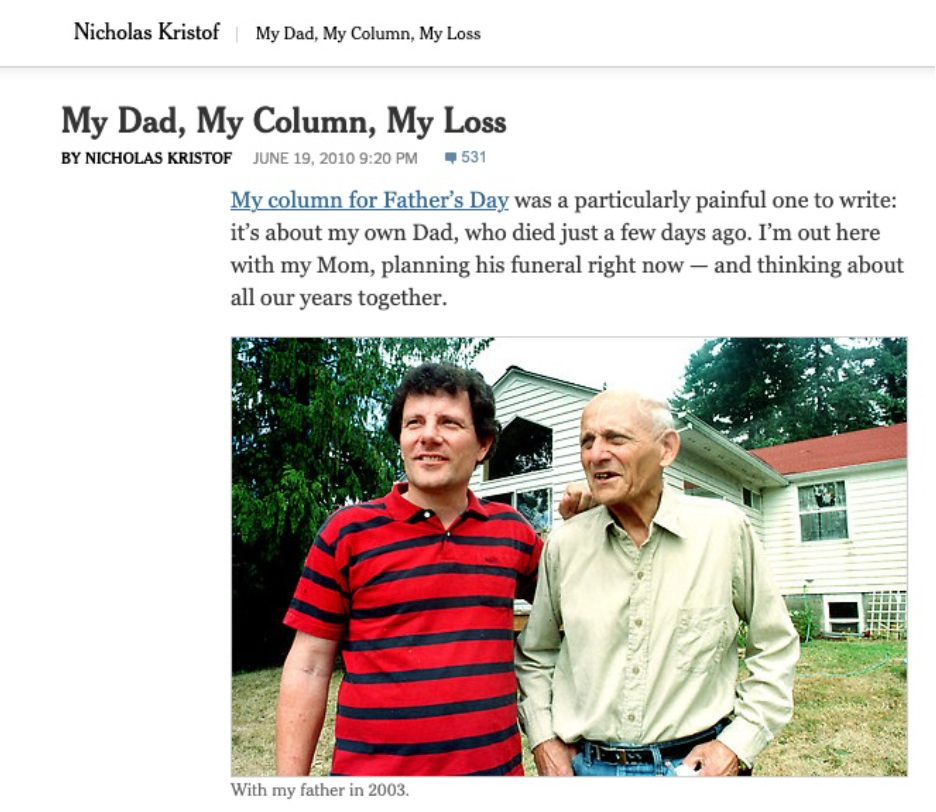
New York Times columnist Nicholas Kristof, left, and his father, who served in the Romanian Army in 1942 while it was allied with Nazi Germany. The Times columnist linked to a newspaper obituary describing his father as a “concentration camp survivor.” (Screenshot)
Times Columnist Kristof’s Father Fought on Nazi Side in World War II
Hamas prison-rape-dog propagandist’s dad also defended Vichy war criminal, then committed suicide after decades of nightmares
Ira Stoll; May 14, 2026
New York Times columnist Nicholas Kristof, whose article accusing Israel of using dogs and carrots to rape Palestinian prisoners is being denounced by the Israeli foreign ministry as "Hamas propaganda," "fabricated," and a "baseless blood libel," had a father who served on the Nazi side during World War II. In Kristof’s 2024 memoir, Chasing Hope, he writes, "When I was growing up and other kids talked about their dads heroically battling the Nazis, I kept quiet. I didn't want to admit that my father had actually fought for a year on the same side as the Nazis."
Kristof’s father also wrote a letter to the editor of the Times in 1989 defending Paul Touvier, the intelligence chief of a pro-Nazi militia in Vichy France who was convicted of killing seven Jewish hostages. Kristof’s father wrote that in World War II, "in so many cases it was sometimes difficult indeed to draw a sharp line between friend and enemy, patriot and traitor, moral and immoral acts. To do good, you often had to do evil too. Time and again, people had to quantify their ethics: I am permitted to be this much immoral to achieve that much good; kill so many to save that many. And once the war ended, it was a question to what extent personal commitments or obligations taken under one set of circumstances were still binding under totally different circumstances, moral and political."
The disclosure that Kristof’s father served in the Romanian military on the Nazi side may help to explain why Kristof would be so eager to demonize Israel in particular when prison abuse cases are plentiful worldwide, and especially in New York. The Princeton historian Bernard Lewis, who had served Britain in World War II from 1940 to 1945 in the Royal Armoured Corps and Intelligence Corps and at MI6, wrote a 2005 article in The American Scholar, "The New Anti-Semitism," in which he observed that "Jew-baiting, Jew-hating, or generally being unpleasant to Jews" serves a purpose by bringing to non-Jews a "kind of relief." Wrote Lewis, "For more than half a century, any discussion of Jews and their problems has been overshadowed by the grim memories of the crimes of the Nazis and of the complicity, acquiescence, or indifference of so many others. But inevitably, the memory of those days is fading, and now Israel and its problems afford an opportunity to relinquish the unfamiliar and uncomfortable posture of guilt and contrition and to resume the more familiar and more comfortable position of stern reproof from an attitude of moral superiority."
Kristof himself acknowledges in his memoir that a "tortuous family history helped turn me into the kind of reporter I became," that "identity can be complicated," and that "all this shaped me." The same memoir says Kristof "would regularly wake in the dark" as a child to hear his dad screaming during the dad’s nightmares.
Immigration documents for Kristof’s father obtained by the Washington Free Beacon show conflicting information about his age and nationality. The documents also indicate that Kristof gave inaccurate information to Times readers about his father’s story. Among the discrepancies:
— His father’s name. A 2010 Times column says, "He arrived as Vladislav Krzysztofowicz, but no American could pronounce that. So he shortened it to Ladis Kristof." Three documents have the immigrant’s name on arrival in 1952 as Ladislas Kristofovici. His 1957 naturalization petition lengthened the name from that to Ladis Kris Donabiet Kristof.
— What ship he was aboard. A 2018 Kristof New York Times column contended, "in 1952, my father was on the deck of the ship Marseille as it approached New York Harbor." Kristof’s memoir says, "in September 1952 my father found himself on the Marseille as it entered New York Harbor." Yet records show the traveler arrived aboard the S.S. Homeland in August 1952.
— What year he arrived. A 2014 Kristof column and a video the columnist recorded for Amnesty International, an anti-Israel advocacy group, said his father arrived in America in 1951, but records indicate that the actual arrival year was 1952.
— His nationality. Documents from 1952, when Kristof’s father was trying to get into America, describe him as "stateless" or of undetermined nationality. His 1957 naturalization petition, however, describes him as being a citizen, subject, or national of Rumania. In that era, U.S. law favored immigrants from Northern or Western Europe and restricted immigration from Eastern Europe.
— His age. Two documents from August 1952 describe him as 32, which would make his birth year 1919 or 1920. Yet his naturalization petition lists his date of birth as November 26, 1918. If that was his genuine date of birth, he would have been 33 when he arrived.
— His place of birth. A document from 1952 describes Kristof’s country of birth as "USSR." A 1957 document describes his place of birth as "Cernauti, Northern Bucovina, Russia." It depends on whether the birth year was 1918, 1919, or 1920, but the city variously known as Cernauti, Chernowitz, or Chernivtsi was in those years either Austria-Hungary or Romania.
— Where he came from. A 2017 Times video produced with backing from Democratic megadonor Laurene Powell Jobs, "Mr. Trump, Meet My Family," put Kristof’s father in Paris, then in New York. Records suggest in-between stops in Germany and Canada.
[Original article shows docs related to the facts and claims stated above]
Such variations are not unusual in immigrant stories. What is unusual is for a Times columnist to write so frequently about his own family member—Kristof wrote about his father in a 2025 Times column, a 2018 Times column, a 2014 Times column, another 2014 Times column, a 2010 Times column, and a 2010 Times blog post, a 2003 Times column, and also starred in the 2017 Times video about him—while also showing so little interest in documentation, such disregard for accuracy, and such determination ("kept quiet … didn’t want to admit") to avoid reckoning openly with his father’s Holocaust-era guilt.
Kristof and his father have offered a series of changing and sanitized accounts of his family history. His family-owned winery in Oregon, which sells pinot noir for $65 a bottle, depicts the columnist’s father as having been on the side of the Allies, omitting his service in an army allied with Hitler during the Holocaust. The winery website says, "At the time the land was first cleared in Yamhill, the Kristofs were an Armenian family living in Eastern Europe. During World War II, family members spied on the Nazis for the Allies, were caught and imprisoned, and eventually had their lands seized by the Communists. After first being imprisoned by the Nazis for spying, Ladis Kristof fled to Yugoslavia and was then imprisoned by the Communists in a concentration camp. Eventually, he was released and made his way to France, but he dreamed of reaching America. In 1952, the First Presbyterian Church in Portland, Oregon, sponsored him, and he arrived that fall and found a job in a logging camp in Valsetz, Oregon."
Three obituaries of Kristof’s father—in the Oregonian, in the American Romanian Academy of Arts and Sciences, at the Association of American Geographers—say he became a U.S. citizen in 1958, when in fact it was in 1957.
[More images of docs proving that Kristof frequently lies about his lineage]
When Kristof’s father died in 2010, a New York Times blog post by the columnist responded to reader skepticism. "Several of you have asked what an Armenian was doing with a Polish name, and where my father grew up exactly. … When my Dad was born, his village was in Austria Hungary, between the wars it was Romania, in WWII it became the Soviet Union, and after the USSR’s collapse it became Ukraine. My father used to consider himself Romanian, but in his later years he identified more as an Armenian. When his siblings telephoned, he spoke Polish with his brother and Romanian with his sister. Complicated story, but you asked!"
The Armenians, conveniently, are widely identified as genocide victims, while the Romanians during World War II—well, as The International Commission on the Holocaust in Romania reported in 2004, "between 280,000 and 380,000 Romanian and Ukrainian Jews were murdered or died during the Holocaust in Romania and the territories under its control. … Referring to Romania, Raul Hilberg concluded that ‘no country, besides Germany, was involved in massacres of Jews on such a scale.’" The commission concluded that, "Of all the allies of Nazi Germany, Romania bears responsibility for the deaths of more Jews than any country other than Germany itself."
The same 2010 Kristof blog post linked to an Oregonian obituary whose headline described the columnist’s father, who became a professor at Portland State University, as a "concentration camp survivor."
A 2018 Harvard Business School case study, "Nicholas Kristof and Sheryl WuDunn: The Power of Writing to Launch and Sustain a Movement," said, "Kristof grew up on a farm in Oregon. His father, Kris, was a Romanian-born World War II refugee of Polish and Armenian heritage who immigrated to the U.S. in the 1950s." The case study says it "was reviewed and approved before publication by a company designate." The "company" in that case would have been Kristof and his wife, Sheryl WuDunn. WuDunn, a 1986 Harvard MBA, is a member of Harvard’s Board of Overseers, one of two governing boards at the university, which is the subject of an antisemitism lawsuit from the federal government. Kristof also did a stint on the Harvard Board of Overseers.
The University of Chicago, in an unsigned biographical note to a collection of posters "collected by Romanian-born political science professor Ladis Donabed Kristof," says, "Ladis ‘Kris’ Donabed Kristof was born on November 26, 1918 in Cernauti, Romania to parents Witold Krzysztofowicz and Maria Zawadzki Krysztofowicz. He studied forestry at the University of Poznan, Poland from 1937-1939, returning to Romania at the outbreak of World War II. Kristof was inducted into the German-allied Romanian army but soon imprisoned for working simultaneously for Polish intelligence; he was released when Romania changed sides in the war in 1944."
Nicholas Kristof, who left the New York Times from October 2021 to August 2022 to pursue a run for governor of Oregon as a Democrat, while living mostly in Scarsdale, New York, provided a different account in his memoir. In the book, Kristof doesn’t claim that his father was spying against the Nazis while in the army. Kristof instead writes, "Romania initially sided with the Nazis to fight off the Soviets, and my dad was drafted into the Romanian army. He was an interpreter and courier. … In early 1943 he became very sick, was demobilized and returned home."
"When I was growing up and other kids talked about their dads heroically battling the Nazis. I kept quiet. I didn’t want to admit that my father had actually fought for a year on the same side as the Nazis," he writes. "Then Romania switched sides in the war in 1944 to join the Allies. So my father had the distinction of being the only parent around who had been on both sides of World War II. But that didn’t seem a good thing to brag about."
The memoir then launches into a story of Kristof’s "cousin twice removed, Izabella Krystofowicz Jaruzelska, a sworn member of the Polish resistance."
"In June 1943, two cars showed up at our family home and arrested Aunt Litka and my grandfather; two weeks later the authorities also arrested my father and uncle. They were all taken to Bucharest for interrogation. … Aunt Litka’s statements in the security files are fascinating: At first, she says almost nothing, and then she steadily amends them as others in the spy ring make confessions that she must respond to. In the end Aunt Litka was sent to a concentration camp in Romania … but she insisted (falsely) that no one else in the family was involved, so my father and grandfather and the others were released."
I emailed Kristof and a Times spokesman to ask, "What evidence do you have that the ‘falsely’ part of that sentence is true, and that your dad participated somehow in the anti-Nazi spying?" I also asked what "concentration camp" his father had been in, and whether it had been a concentration camp or a displaced persons camp. "Do you have any additional information or evidence on what your dad did between early 1943 when you say he left the Romanian army and 1948 when he swam the Danube River? Or on how he handled the murder of the Jews of North Bukovina while it was ongoing?" I also asked whether Kristof’s father had been completely truthful about his World War II record in his communications with U.S. immigration authorities.
I heard back from the Times spokesman, Charlie Stadtlander, who replied, "these are dangerous, inflammatory and most of all false insinuations. As detailed in his book Chasing Hope, Mr. Kristof's father's family—who were Armenian—spied on the Nazis and were caught in 1942/43. One of his relatives died in Auschwitz as a result, and another was subjected to medical experiments there." Stadtlander is now insisting the family "were Armenian" but Kristof himself had acknowledged, in writing for the Times, "My father used to consider himself Romanian, but in his later years he identified more as an Armenian." Stadtlander's statement dodges the distinction about whether, and when, Kristof’s father himself spied on the Nazis, or whether just his "father’s family" did.
Kristof, whose specialty as a Times reporter has been globetrotting on-the-scene reporting from the scenes of humanitarian crises, has made at least two visits for the Times to his family’s hometown.
In a 2014 column datelined "KARAPCHIV, Ukraine," he wrote, "When my father was born, it was Austria-Hungary. Throughout his childhood, it was Romania. In the 1940s, it became the Soviet Union. In 1991, it became the Republic of Ukraine."
In a 2003 column, he wrote, "The woes of this little village of Karapchiv are, to me, a particularly poignant window into all that went wrong and still goes wrong in the late U.S.S.R. -- for in an alternate universe, it would have been my home. My father's family, émigré Armenians, lived here in what was then Romania, now a short drive south. Then the Soviets seized this land in 1944 and sent my father fleeing on a long, bumpy journey to Oregon … So my heart pulses with competing emotions as I stand in front of the Kristof family home here (actually, it's the Krzysztofowicz family home, for my father shortened the name after arrival in the U.S.)." He went on, "I'm sure the Communists did us a favor by evicting us and pushing us toward America. The old system, in which a few wealthy families like mine exploited vast numbers of peasants, was unsustainable and, frankly, a pretty good argument for Communism."
The wealth part, at least, the columnist got right. His father wrote on March 24, 1956 to the Foreign Claims Settlement Commission of the United States in Washington, trying "to obtain some compensation" for "180 hectares of arable land and 750 hectares of forest, and half of an alcohol plant with a yearly production capacity of 250,000 liters of pure alcohol, nationalized by the Soviets in June 1940," estimated value in 1940, $180,000. That sum is equivalent to $4,251,319 today; a hectare is 2.47105 acres. Kristof’s memoir says "the Soviets seized Northern Bukovina in 1944, appropriating my family’s lands and wealth." The difference between the 1940 and 1944 dates are another inconsistency in the story, covering years when a lot of Jews were being murdered there.
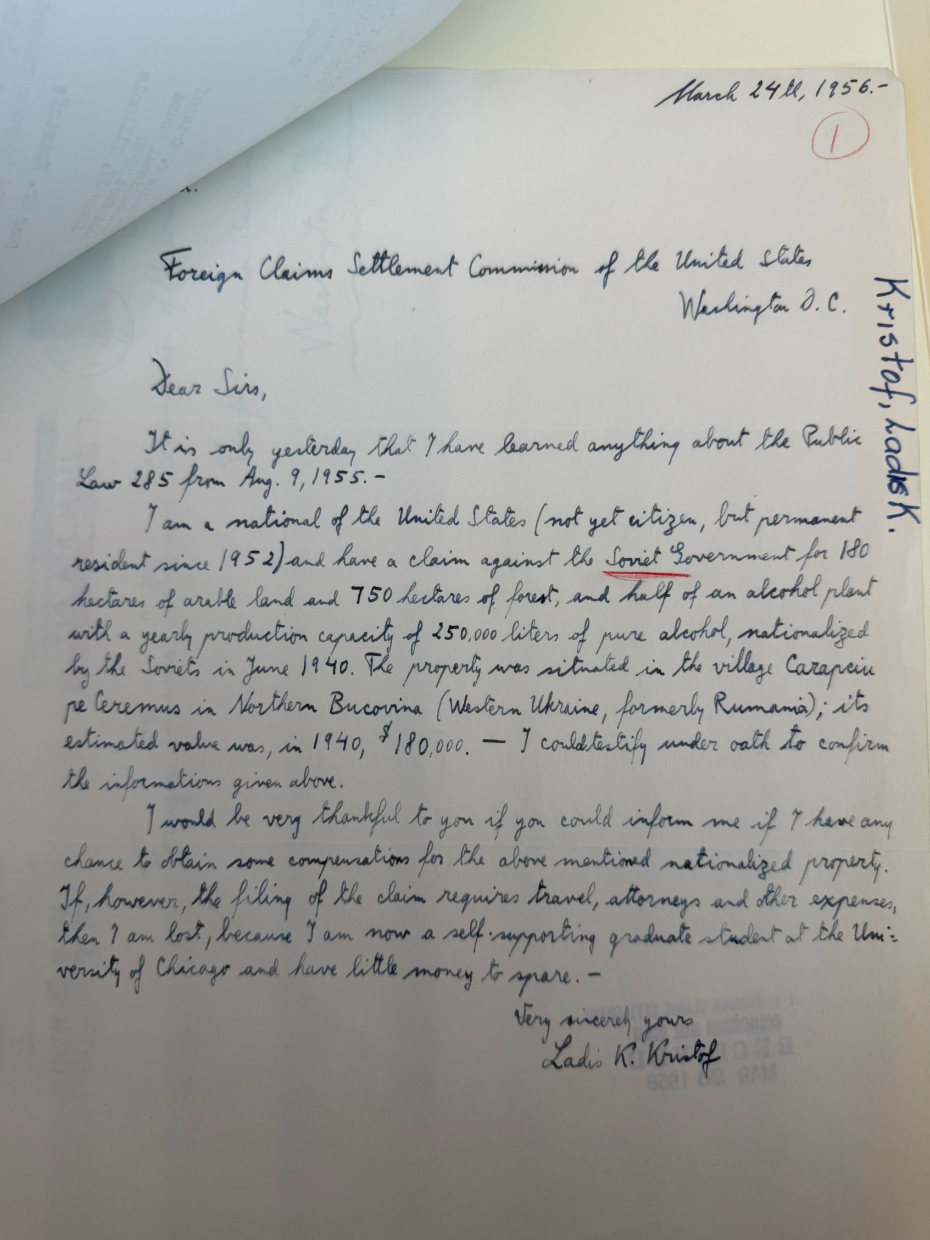
A letter from Kristof’s father seeking compensation for land and "half of an alcohol plant" in Northern Bukovina.
In neither of the columns does Kristof display much curiosity or interest about the fate of the surrounding Jewish communities, though nearby Chernowitz, where the Oregonian obituary said Kristof’s father had been born (using the Romanian name Cernauti) was a center of Jewish culture and early home to eventually prominent figures such as Harvard Yiddish professor Ruth Wisse (who fled in 1940) and the eminent Israeli novelist Aharon Appelfeld.
Such information is readily available; for example, Israel’s Holocaust memorial at Yad Vashem includes a video of testimony from a Jewish child of Karapchiv, Pnina Pearl Kaltman, who described her own father’s murder: "they dug a large pit, they shot everyone in the back … By the Germans, Romanians? It was probably together. The Romanians, but with the encouragement of the Germans. … that villager came back and told us that father wasn't even murdered; he was only wounded. He fell into the pit, and he saw him trying to remove the dirt from his eyes and trying to crawl out of the pit. But apparently the strength, he didn't have the strength, and he stayed with all the Jews there inside that pit. And somewhere there is a mass grave. We never returned there."
Kristof has vacillated between hubris and humility in assessing his own ability to sort truth from fiction. In the Harvard Business School case, he claims, "I have developed a sense over the years about sniffing out the truth from the people I interview. People lie, exaggerate, or misremember things. People exaggerate when they’re talking about murder. I saw that in Tiananmen Square. If I get something wrong then my credibility is on the line." In his memoir, he conceded, "Myriad mistakes punctuate my career."
In 2010, Kristof’s father committed suicide, shooting himself with a .308 hunting rifle. The Times columnist puzzles over it in his memoir: "Why had my father killed himself?"
He writes that in the days before, "He spoke frequently of his childhood home in Romania, and one day he suggested we all drive over to his native village."
Thoughts?
Personally, I cannot wait to see how Nicholas Kristof once again turns a conflict that does not directly affect him into a performance about himself. Will he recycle the “Jews are fake victims” line popularized by celebrities like the lead singer of The Strokes (shortly before they released one of the worst albums of the century)? Will he continue making baseless accusations because he knows large parts of his audience will either believe them or pretend to? Almost certainly.
My bet: he demands sympathy for being forced to learn more about his father’s real history, and, safe bet, insists the Zionists are derailing his career as an honest person, whose father’s history should never be questioned.
For context, a little over a decade ago, one of the popular “Free Palestine” talking points was that the reason there were no accusations of Israeli soldiers raping Palestinian women was... racism. Yes, really. That was an actual argument advanced by activists at the time: that Israelis were supposedly “too disgusted” by Palestinian women to assault them.
The argument essentially boiled down to: “We expect mass wartime rape to happen, but Israelis are not behaving the way we predicted, therefore the explanation must be racism.” That is ideological brain rot I expect from this cult.
And honestly, it shows that the movement has refined its propaganda. The older arguments were comically deranged. Today’s versions are more polished, more emotionally manipulative, and only funny to a very dark sense of humor. They get past New York Times editorial standards.
I would genuinely wager the Kristof piece drew far more traffic than the Times’ surrounding articles. And really, who can blame a struggling media empire for sprinkling in a little blood libel for engagement? Running ads on formerly free games like Wordle can only generate so much revenue.
Note: I can’t find the embarassing Haaretz piece, but I read it back then. Here’s some pieces covering it after: 1. Israel National News summary: https://www.israelnationalnews.com/news/391832 2. Jerusalem Post discussion: https://www.jpost.com/opinion/op-ed-contributors/israels-modern-day-feminists-316654 3. FrontPage Mag summary discussing the “too disgusted” framing: https://www.frontpagemag.com/ex-israeli-soldier-denounced-us-campus-not-raping-daniel-greenfield/ They updated the lie from “it didn’t happen cause racism” to “it did happen, trust us.”]