Intro
I support Ukraine for the same reason I support Israel: progressive and secular human rights matter more than flags.
Ukraine and Israel are closer to the kind of societies I want to live in. They are more LGBT+ friendly, more democratic, more tech-forward and far more interested in building functioning countries than conquering their neighbors.
This isn't to say I have no sympathy for people who hate us Ukraine and Israel supporters. I get how somebody sees death, destruction and grieving families, then blames the people dropping the bombs rather than the people who started the war. We have created a world where invaders who massacre peace activists get sympathy.
To repeat something on my blog (ugh, sorry): World War II is too often remembered in a sanitized way, ‘Hitler did bad things, Hitler died, the war ended, everybody hugged and went home.’ It’s easier than remembering that many Nazis, even in the US, just gave up because they grew tired, not because their ideology changed. It’s easier than remembering that the Jews were left in the concentration camps, homes burned down, with the surviving having resettlement in Israel as their only option.
Wars involve entire societies and whether loyalty to their government mattered more than basic morality. They involve states, not just as in the proper nouns, but the state of mind that makes a Nazi or Palestinian who will defect or die on command.
PS: Read my older piece about October 7 being Putin's actual birthday and the other reasons I believe Russia (not Iran) was more involved in Gaza’s invasion of Israel than people realize: Read “Never Forget: Russia Started This War”
Ukrael vs. Russiastein
One of the starkest differences between my side, let's call it Ukrael, and the invading side, which we can call Russiastein, is what happens when people decide they are fighting for the wrong team.
Ukraine and Israel do have dissidents. They have well-paid whistleblowers, refuseniks, whole parties dedicated against their own statehood. Yes, some make entire careers out of criticizing their own state.
But Russia's war has produced something more dramatic: Russian soldiers, sailors and civilians who have not merely criticized Putin, but surrendered to Ukraine, passed intelligence to Ukraine, sabotaged Russian military equipment and, in some cases, picked up Ukrainian weapons and started directly fighting the army they once belonged to.
This isn’t Jude, so I’ll keep the random Israel parallels short: 1. The Green Prince, Mosab Hassan Yousef, is the classic example: the son of a Hamas founder who secretly worked for the Shin Bet for years and provided intelligence against Hamas. 2. Ra'am leader Mansour Abbas accepts Israel outright, explicitly saying that Israel was born a Jewish state and will remain one. 3. Hamas regularly accuses Palestinians of collaborating with Israel and has executed alleged collaborators. Whether any particular accusation is true is difficult to know when your judicial process is public hangings and torture without trial. 4. More anecdotally, Israeli friends involved around Gaza have told me that leaflets and calls asking civilians for information generated enormous numbers of responses from Palestinians hostile to Hamas or simply desperate for the war to end.
Back to the topic.
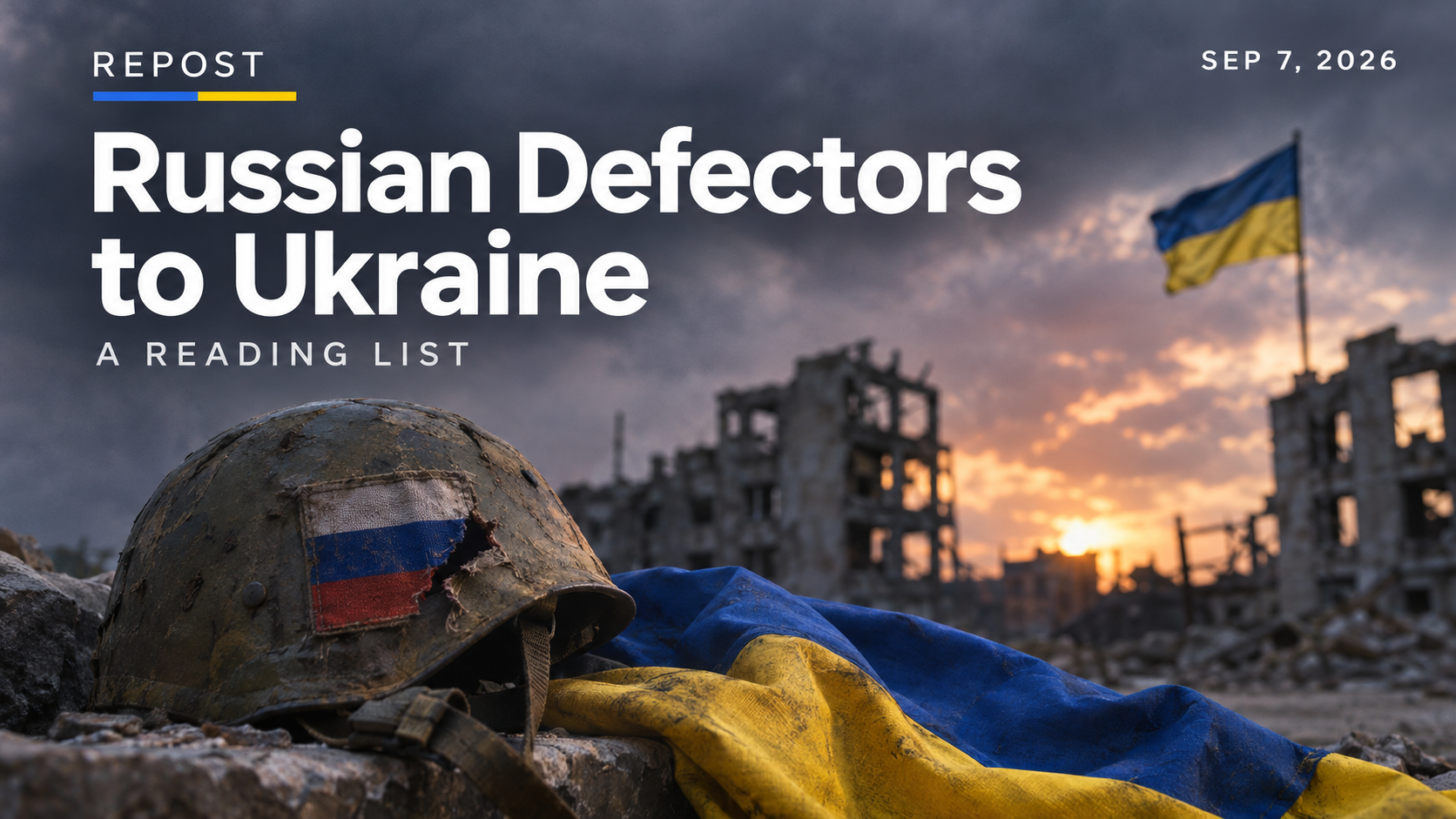
#SlavaUkraine
Russia's war against Ukraine began in 2014, with the full-scale invasion in February 2022. It has devastated Ukrainian families.
Living in Israel, I don't only see the videos of blown-up apartment buildings and battlefields. I meet Ukrainians who cannot safely go home. I see them carrying enormous guilt because their country is fighting for survival while they feel unable to help. I have seen what displacement, helplessness and years of war can do to people's mental health, including acquaintances who gained drug addictions and others who committed suicide.
I've also met more Russians who ran. Young and old. Some left almost immediately after the invasion, citing political differences. Others left after mobilization began, not wanting to be conscripted. They were willing to move anywhere rather than be forced into a war they didn't believe in. Most have stories of temporary residence in freezing, remote parts of Kazakhstan, before eventually reaching Georgia, Israel or somewhere else where they could rebuild their lives.
Yes, obviously this is filtered through my social circle, and millions of expat Russians do support Putin. But the contrast I've personally encountered is striking: Ukrainians desperately missing home and wanting their country back, while many Russians I've met talk about their own government with embarrassment, disgust or outright shame.
Today’s reposts are about the Russians who went much further than leaving. I am too lazy to repost all of these articles individually, especially because I have already reposted The Guardian before (despite truly hating it more than any other legacy publication). So here is the reading list of articles you can dive into, if you choose, alongside edited ChatGPT descriptions:
Jan 26, 2023: The Guardian, “‘I want to live’: the Ukraine hotline encouraging Russians to surrender”
Ukraine created the I Want to Live program after Putin's mobilization order, giving Russian servicemen a way to contact Ukraine before surrendering. According to Ukrainian officials interviewed for the story, Russian soldiers could provide identifying information, establish contact while still on the Russian side and then receive instructions for getting safely into Ukrainian custody.
By Jan 2023, Ukraine claimed that 6,543 Russian personnel had contacted the service. The Guardian notes that it could not independently verify that number, and contacting a hotline is obviously not the same as successfully crossing the front and surrendering.
Ukraine built an actual system around defection rather than treating every Russian soldier as someone who simply had to die. The article describes hotline operators fielding messages from frightened Russian soldiers, including units that were collapsing during Ukraine's liberation of Kherson. Those who surrendered could potentially enter prisoner exchanges, remain in Ukrainian custody or eventually seek another future outside Russia.
In the later reposts, I Want to Live comes up again. Russians actively helped Ukraine fight back.
May 24, 2023: Deutsche Welle, “Who are the Russian volunteers fighting for Ukraine?”
The article focuses largely on the Freedom of Russia Legion and the Russian Volunteer Corps, two Russian formations fighting on Ukraine's side. They should not be treated as ideologically interchangeable. Different Russian anti-Putin groups contain different politics, and some factions have attracted controversy over the ideological backgrounds of their members.
One of the people DW mentions is Igor Volobuev, a former vice president of Russia's state-owned Gazprombank who left Russia and joined the Freedom of Russia Legion. The article also discusses Russians who had been prisoners of war before switching sides.
By this point, the war wasn't merely Russia versus Ukraine in the most literal national sense. There were Ukrainians collaborating with Russia and Russians taking Ukrainian weapons to fight Putin. That complicates the comfortable idea that wars are simply two homogeneous populations who naturally hate each other.
Dec 14, 2023: AP, “Dismayed by Moscow's war, Russian volunteers are joining Ukrainian ranks to fight Putin's troops”
The AP piece follows the Siberian Battalion, another Ukrainian military unit composed largely of Russian citizens. Its central figure is a Russian using the callsign Karabas, who was living in Moscow when the invasion began. He describes becoming horrified not only by what Russia was doing in Ukraine, but by how many people around him either supported the invasion or seemed completely indifferent to it.
AP describes a process that took him close to a year, including leaving Russia, traveling through Armenia, undergoing extensive Ukrainian security screening and eventually joining the battalion.
The Siberian Battalion is particularly interesting because many of its members come from Siberia and Russia's Far East, including ethnic minorities who describe discrimination and domination from Moscow. For some, fighting Putin is connected not only to Ukraine but to their own ideas about what post-Putin Russia should look like.
This one is less about spontaneous battlefield defection and more about Russians consciously deciding that Russia winning would be worse for their own state than Russia losing.
Feb 24, 2024: The Guardian, “On the run from Russia: the defector to Ukraine shot dead on the Costa Blanca”
This is the most cinematic and depressing story on the list.
Maksim Kuzminov was a Russian military helicopter pilot who secretly cooperated with Ukrainian intelligence. In August 2023, he flew his Mi-8 helicopter into Ukrainian-controlled territory and defected.
Ukraine paid him, gave him a new identity and reportedly offered him the possibility of remaining in Ukraine. According to the Guardian, Ukrainian intelligence officials warned him that leaving Ukraine for western Europe would make protecting him extremely difficult. He left anyway and settled in Villajoyosa, Spain.
On February 13, 2024, the 28-year-old was found shot multiple times in the underground parking garage of his apartment complex. The killers reportedly escaped and burned their getaway vehicle.
Moscow publicly celebrated his death. Russian intelligence chief Sergei Naryshkin described Kuzminov as a traitor and criminal. Russia did not formally claim responsibility for the killing.
It is an extraordinary story because it shows exactly why defection is not merely a matter of changing uniforms. For somebody with useful intelligence who humiliates the Russian military publicly, crossing the Ukrainian line may be the beginning rather than the end of the danger.
Aug 20, 2024: Ukrainska Pravda, “Ocheret special operation: 24-year-old Russian soldier defects to side of Ukraine”
Read the Ukrainska Pravda article
Silver was the alias of a 24-year-old Russian serviceman who ended up serving in one of Russia's Storm assault units. According to Ukraine's I Want to Live program and the Freedom of Russia Legion, he deliberately signed a Russian military contract as part of his plan to get close enough to cross over to Ukraine.
But he didn't simply walk across the line.
While still inside the Russian military, he allegedly spent months cooperating with the Ukrainian side and passing along information. His operation culminated in an attack on his own unit before he escaped and joined Ukraine.
This is where the distinction between surrender, desertion, espionage and defection starts disappearing completely.
A Russian citizen joined the Russian military, secretly cooperated with Ukraine from inside it, acted against his Russian unit and then crossed over to join the Freedom of Russia Legion.
Whatever you think about defectors in principle, that's a hell of a commitment to the belief that your own government is the bad guy.
Aug 31, 2026: Sky News, “‘Run you fools, you will die’: Meet the unit of Russian defectors fighting for Ukraine”
Finally, the article that made me want to put this roundup together. Sky News gets unusually deep access to members of the Freedom of Russia Legion, and rather than treating them as a mysterious bloc of “anti-Putin Russians,” it tells several completely different stories about how people ended up there.
One is Goga, a former Russian navy radio operator stationed aboard the Serpukhov, a missile ship capable of carrying weapons used against Ukraine. He says he opposed the invasion, tried to leave military service legally and was refused.
Eventually he began cooperating with the Ukrainian side. Before escaping Russia, he gathered classified documents, brought fuel aboard the ship and started a fire in its communications compartment. He then fled toward Lithuania.
Another is Erik, who was mobilized into the Russian army in 2023 and assigned to a Storm unit in occupied Ukraine. Rather than simply deserting, he says he began collecting operational maps and information about Russian positions so he would have something valuable to bring with him.
He contacted I Want to Live, coordinated his escape with Ukraine and eventually crossed the front through an area containing mines. During the operation, Ukrainian intelligence also asked him to help bring two stranded Ukrainians across with him. He did.
The article also profiles Zirka, whose path was completely different. She had been working in Paris fashion before joining the Legion as a combat medic because she felt volunteering safely from France was no longer enough.
And in one of the strangest scenes in the article, a Russian soldier surrenders to a Ukrainian drone without realizing that the people accepting his surrender are themselves Russians who switched sides.
Goga's advice to Russian soldiers still serving Putin is considerably shorter than this blog post:
“Run, you fools. You will die.”
At some point, “every Russian supports Putin” stops being merely simplistic and becomes insulting to the Russians taking enormous personal risks to prove otherwise.
The Point
Thousands of people have been willing to flee Russia rather than participate in Putin’s invasion. Some Russian servicemen have surrendered, others have provided intelligence. A smaller and much more extraordinary group has sabotaged Russian forces and then voluntarily gone back into combat wearing Ukraine's uniform.
I do not see the parallel of this. I do not see Ukrainians joining Russia’s army, except kidnapped children. I do not see Israelis joining Hamas (which would, of course, be suicidal). And this contrast speaks volumes.
We should be well past fighting for countries and governments, and onto fighting for civil rights and referendum. I simply don’t care about flags, only what they represent. If your state starts a war, choose if it’s really your state.