Who’s Next to the Happy Merchant?
By now, everyone has seen the so called “Happy Merchant” meme. Some know it as the “Big Nosed Jew” meme. Most don’t know its history, but that ignorance isn’t helping their case. It’s not edgy humor or “criticism of Zionists.” It’s one of the most recognizable antisemitic propaganda images circulating on the internet.
The cartoon dates back to 1992. A white supremacist illustrator named Nick Bougas published racist cartoons under the pseudonym A. Wyatt Mann (not subtle joke meaning “a white man”). Bougas spent years producing grotesque propaganda drawings targeting minorities. This was the one that survived, became widely recognizable, largely because antisemitic imagery has a longer shelf life online, where The Protocols are regularly recycled.
Nick Bougas was not just an anonymous troll who made cheap jokes, proving comedy should be left to professionals. His entire body of work revolves around shock propaganda. That’s all he did. His drawings circulated in white supremacist circles. Outside of those cartoons he was involved with crap movies and the deliberately offensive magazine Answer Me!, publishing material celebrating misogyny, mocking victims of violence and ridiculing minorities. He also bastardized Satanism, using its aesthetic of provocation and anti-Christian rebellion as cover for material that went far beyond philosophical critique and into outright racial hatred.
Yeah, he made Satanists look bad.
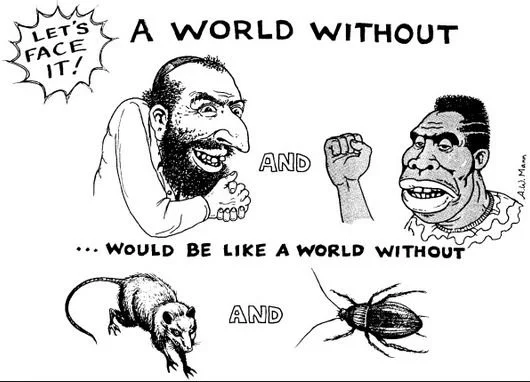
The image that circulates today is almost always cropped. Here it is in full, so you can see why:
Where that garbage “meme” comes from
The familiar caricature of the scheming Jewish merchant rubbing his hands together originally appeared alongside a racist caricature of a Black man. The full panel delivered its message bluntly:
“A world without Jews and Blacks would be like a world without rats and cockroaches.”
The image people casually share today comes from propaganda equating Jews and Black people with vermin.
But something interesting happened over time. The part mocking Black people disappeared. If the full cartoon circulated today, it would trigger immediate outrage. Facebook would flag it almost instantly. So the bigots simply cropped the image.
Blackface imagery, minstrel caricatures, and racial stereotypes were rightly condemned for decades. Entire academic fields formed around understanding why those images are harmful. We even reached a point where people debated microaggressions and criticized Halloween costumes that resembled blackface.
Then Jews became the target, and that public shaming faded.
The Happy Merchant survives the purge not because it is less offensive, but because the people deciding what counts as offensive convinced themselves that hatred toward Jews is “punching up.” Once that idea took hold, antisemitism could simply be rebranded as antizionism.
The next time you see someone sharing the Happy Merchant, ask, “Why aren’t you showing the full cartoon?”
You’ll either get left on read, blocked, or the truth that these people don’t really care about Israel-Palestine, they’re just using it as their mask to be openly racist.